Wednesday, 30 July 2008
Use Keywords In Page Titles
Use Keywords In Page Titles
It is recommended to use keywords in page titles itself. This title tag is different from a Meta tag, but it's worth considering it in relation to them. Whatever text one places in the title tag (between the title and portions) will appear in the title bar of browsers when they view the web page. Some browsers also append whatever you put in the title tag by adding their own name, as for example Microsoft's Internet Explorer or OPERA.
The actual text you use in the title tag is one of the most important factors in how a search engine may decide to rank your web page. In addition, all major web crawlers will use the text of your title tag as the text they use for the title of your page in your listings.
If you have designed your website as a series of websites or linked pages and not just a single Home Page, you must bear in mind that each page of your website must be search engine optimized. The title of each page i.e. the keywords you use on that page and the phrases you use in the content will draw traffic to your site.
The unique combination of these words and phrases and content will draw customers using different search engine terms and techniques, so be sure you capture all the keywords and phrases you need for each product, service or information page.
The most common mistake made by small business owners when they first design their website is to place their business name or firm name in every title of every page. Actually most of your prospective customers do not bother to know the name of your firm until after they have looked at your site and decided it is worth book marking.
So, while you want your business name in the title of the home page, it is probably a waste of valuable keywords and space to put it in the title line of every page on your site. Why not consider putting keywords in the title so that your page will display closer to the top of the search engine listing.
Dedicating first three positions for keywords in title avoiding the stop words like ‘and’, ‘at’ and the like is crucial in search engine optimization.

How to Get Yahoo Answers Taffic !
Yahoo Answers is a powerful subcategory of the mighty Yahoo search engine which allows people to ask questions and receive answers from other internet users. This is the tool many people fail to leverage to build their websites traffic and get exposure, plus to build credibility of the webmasters themselves. Below are the ways I would recommend to anyone to use Yahoo Answers to further develop their websites:
Answer As Many Questions As Possible
Dedicate certain hours in a week to answer questions posted in Yahoo Answers with credible and informative information. Many people tend to promote affiliate link or bluntly promote their website without giving any reasonable answers. This is wrong. Here is the logic, if you are a person who post a question, you would be expecting some answers straight to the point and not some promotional links which does not carry much value or long winded answers.
Answer Within Your Niche
Focus in answering questions related to your site niche. Remember, you main task is to build your credibility and expose your website. Therefore, by answering questions within your niche, people who constantly read your answers will recognize your expertise.
Answer Using Certain Keywords For Search Engine
Whenever you could answer certain questions, try to pick a phrase of keywords which you would like to use in your answer. Repeat the phrase few times (usualy 3 to 4 times) or keywords density of 4% in your answers. This will help people to find your answers especially when they do a search engine queries.
Leave A Link In Your Answer
This is another reason why you need to answer question within your niche. When you provide a good and solid answer, you have the opportunity to let people know where they could get further related information by leaving a link at the bottom of your answer. The link should bring the readers straight to the page which contain the information.
Build Your Backlinks Using Yahoo Answers
Now, when ever you leave a link in your answer, you are actually building a backlink to your site. If you link as many pages within your website to certain answers, this will help further to improve your page rank and other benefits which are related to backlinks. Yahoo Answers is heavily indexed by search engines due to its dynamic content nature. Therefore, when a spider visits a newly answered questions which have links to your website pages, it will index your site too.
Many people have mentioned of using YouTube to build large amount of traffic. But Yahoo Answers too could be used to build your traffic. Remember, the answers you give does not only appear in Yahoo Answers website, but also in search engine query results. It helps to build your organic traffic which is free and more targeted.
Make unique content and Check similarilty stays unique!
Search for copies of your page on the Web. is a great tool for checking unique content
Resource
and
Similarity Analyzer
Most search engines compare the text of web pages to filter out resources with too much similar or identical texts from search results.
This similarity analyzer tool compares two web pages calculating some statistics about their HTML code similarity and their text similarity. An HTML code similarity value can be used to identify pages belonging to the same site/network, while a text similarity value is useful to find duplicated or near-identical text contents.
Resource
Check your published or unpublished article for plagiarism or unintentional copying. Avoid duplicate content penalties by search engines.
Resource
Unique Content Generator!
link
Tuesday, 29 July 2008
SEO Glossary - Definitions of common SEO terms
SEO Tools - Alexa Rank Comparison
The Alexa Traffic History Graph lets you to make a traffic history graph for any website. Alexa calculates traffic rankings by examining the Web usage of lots of Alexa Toolbar users.
What is Traffic Rank?
The traffic rank is depends on three months of cumulative historical traffic data from lot of Alexa Toolbar users. It is a shared measure of page observation and users (reach). The three-month modification is determined by contrasting the site's current rank with its rank from three months before.
What is Reach?
Reach tells about the number of users. Reach is characteristically expressed as the proportion of all Internet users who visit a known site. Alexa tells about the users as per million. The three-month changes are determined by contrast a site's current reach with its standards from three month ago.
6 SEO Tools - Check Server Headers
Make sure server headers and confirm HTTP status codes. There are seven HTTP status codes that we are mainly involved in from an indexing and search engine marketing point of view. It is suggested that you confirm your URIs are recurring the proper Status-Code in the Server Header.
Status Code Description
200 OK The application has succeeded. The information go back with the response is reliant on the method used in the application.
301 Moved Permanently The application resource has been allocating a new permanent URI and any future orientation to this resource must use one of the returned URIs.
302 Found
The application resource resides for the moment under a dissimilar URI. Since the redirection might be distorted on occasion, the client must carry on to use the Request-URI for future requests.
304 Not Modified
If the client has carry out a conditional GET request and access is permissible, but the document has not been customized, the server must respond with this position code. The 304 response should NOT hold a message-body, and thus is always ended by the first unfilled line after the header fields.
307 Temporary Redirect
The requested resource exists in temporarily under a dissimilar URI. Since the redirection MAY be distorted on occasion, the client SHOULD continue to utilize the Request-URI for future requirements. This response is just cacheable if point out by a Cache-Control or terminates header field.
404 Not Found
The server has not found something matching the Request-URI. No sign is given of whether the circumstance is temporary or permanent. 410 Gone The requested reserve is no longer obtainable at the server and no onward address is recognized. This condition is predictable to be measured permanent.
SEO Tools - Class C Checker
The Class C Checker implement allows you to make sure whether a number of sites are hosted on the identical Class C IP Range. You might desire to utilize the Class C Checker if you own numerous cross-linked sites. If you perform, it may be additional efficient (for SEO reason) to host them on unrelated Class C IP ranges. Additionally, if you are going away to get original links from unrelated sites, you may desire to see whether they share the unchanged Class C IP range. Again, this can make a variation for SEO reason.
SEO Tools - Code to Text Ratio
What is the Code to Text Ratio?
The system to Text Ratio stands for the percentage of genuine text in a web page. Our satisfied ratio instrument extracts the text from section and the fasten text from HTML code and compute the contented ratio based on this in order.
Why is the Code to Text Ratio Important for SEO?
The rules to text ratio of a page are second-hand by search engines and spiders to compute the relevancy of a net page. An elevated code to text ratio offer you a better chance of receiving a superior page ranking for your page. Not every search engines are via the code to text ratio in their catalog algorithm, but the majority of them perform. So having an elevated code to text ratio than your contestant gives you a good quality set up for on-site optimization.
SEO Tools - CPM Advertising ROI Calculator
This calculator events your ROI (go back on investment) if you are via the CPM (cost per thousand) impressions publicity model universal to most banner and button ad crusade. Total monthly imitation from your CPM publicity This segment of the implement lets you put in previous month's number to calculate previous month's ROI. You can as well project after that month's number to calculate next month's latent ROI.
Estimated average CPM
Here you know how to put in previous month's number to calculate previous month's ROI. You can too project after that month's number to calculate after that month's potential ROI.
Click-through rate
Your click-through rate is the proportion of definite click-through for each number of imitations. For example, if you give for 5,000 imitations and obtain 50 click-through, your click-through rate would subsist 1%. Go into a percent number, not a portion. For occurrence, for 10% enter 10, not 0.10.
Conversion Rate
Your adaptation rate is the percentage of guests who approach to your site from a banner or button and convert into clientele, for example, by making a buy. Conversion rates differ by business, but an average adaptation rate you can utilize as a test would be alive 2-3%. Enter a percent integer, not a segment. For example, for 10% enter 10, not 0.10.
Average profit per conversion
Profit refers to the extent of cash you receive from a sale. For example, if you put up for sale a software package for $100 and it just price you $10, your earnings is $90. You have to supply this number as of your own records by approximation the average amount of income you generate from every conversion.
SEO Tools - Domain Age
A website’s period is one of the main factors used to rank it in the look for engines. Use this implement to find the time of some domain, counting your competitors’ or ones you might desire to buy. Big domains may obtain a slight edge in look for engine rankings.
SEO Tools - Future PageRank
This implement will inquiry Goggle’s diverse data centers to check for some changes in Page Rank standards for a known URL. Frequently all data centers will productivity the same, but if reservation throughout an update, you might obtain a glimpse of some upcoming alter in your selected URL's Page Rank value.
SEO Tools - Keyword Suggestions for Google
The Keyword offer implement for Goggle will help you choose pertinent and popular terms connected to your chosen key term. Just enter an input term and this implement will query in order from several Google look for, which it will utilize to determine well-liked and re-occurring stipulations used by websites in the identical industry. The relevancy of an input term is determined by including the number of times a particular term occurs. You can notice that on circumstance a term has an elevated significance than the term you go into. This is because it appears more often in Google searches related to your term than your input term does.
WARNING: Depending on Internet traffic because well as the keyword/phrase you decide, this reservation may take everyplace from 10 to 30 seconds to full. Please be patient.
SEO Tools - Multiple Data Center Google Search
This implement look intended for your keyword/phrase in dissimilar Goggle data middle. There is a lot of different Goggle data middle. All of these may respond with dissimilar results for the similar look for query. If you see consequences that differ from data middle to data center, it resources that Goggle is in the procedure of inform its index.
SEO Tools - Google Suggest Scraper Tool
The Google Suggest implement provides regularly searched expression based on the letters or vocabulary in your query. This keyword proposition tool produces ten keywords suggested by Google for the look for term you afford. Type in an expression or part of a word to produce connected keywords.
SEO Tools - Google vs Yahoo Search Results
This implement will run a look for query in the Google and Yahoo exploration engines and then graphically contrast the results. Users can contrast the keyword position on every search engine’s consequences. A line is drawn flanked by Google and Yahoo consequences for the same URLs. From these consequences you will notice how every search engine gives dissimilar page ranks for dissimilar pages by comparing their look order. Mouse in excess of the dots to see the URLs they stand for. Click on them to unlock the URL in an innovative browser window.
Monday, 28 July 2008
Microsoft & Google bidding on digg.com
In the competition of market most of companies will go in cartel, trust or acquisitions. In the series, Search Engines and Social sites are also in competitions. To expand their market in online marketing or search marketing they are adopting a policy of acquisitions.
Before some months Yahoo, worlds 2nd largest search engine was on sale and bid from Microsoft announced $44.6 billion. But it was less amount for it. That is why it is now continue for bid. In this series Yahoo was already acquired a social bookmarking site which is most famous nowadays - “Del.icio.us”. We know del.iceo.us is a social bookmarking site to store, share and discover web bookmarks. It provides web services to bookmarks. Its founder was Joshua Schachter and in late 2003 the site was started. In 2005, it was acquired by Yahoo.
Next in this series now, digg.com is on bid. We know digg was started in 2004 by a team Kevin Rose, Owen Byrne, Ron Gorodetzky, and Jay Adelson. Digg is also a social bookmarking site. Now Currently, Owen Byrne is in active role for it. About Google bid there is a news that its bid amount is $200 to $225. However, Microsoft is also trying for it in lower amount.
It seems, in online marketing Google is going to acquire web services and web add services. In this competition, Microsoft is also trying to be a strong competitor.
However, about this story Jay Adelson, who run digg blog, writes, “Normally our policy is to not comment about things like this, but this morning’s rumors about a bidding war involving Google and Microsoft have created such a stir we feel compelled to tell you all directly that they are completely inaccurate.
Sorry to burst any drama theories, but they aren’t true. We remain focused on improving Digg and rolling out great features.”
What is the truth, we see next.
Google digger deeper!
Sunday, 27 July 2008
Microsoft Testing Self-Serve Publisher Advertising Product
They should benchmark your integrated so that your strategic s might monetize your B2B Still, if Microsoft is willing to take a bath and pay publishers more than Google does, they can get a lot of page views quickly and build up inventory., yet my Microsoft is testing a new pilot program that will let third party publishers add Microsoft’s contextual ads next to their content in a self-serve format. From what we can tell from the email below, it will be very similar to Google’ Adsense and Yahoo’s Publisher Network. is closed. When I interviewed my visionary , my plug-and-play Microsoft’s self-serve advertising offering for publishers is still under development and is currently in a private pilot phase, being tested by select publishers who met the participation requirements. The private pilot phase began earlier this year. A private, phased approach allows us to learn more about customer interest in content advertising and provide guidance as to how we can improve the product and deliver the right features required to meet publisher and advertiser needs. It’s our intention to continue to expand our high quality network and relevant audience gradually and intelligently over time for our advertisers. We will evaluate customer interest and product performance as we move through the private pilot, but we have no specific launch plans to announce at this time. guided my world-class Update: A Microsoft spokesperson says this trial has actually been underway since earlier this year with a small group of publishers, but won’t say when or if this will officially roll out publicly.. Your is negotiated as though they dispensed your Full email is below. I’ve contacted Microsoft for a comment. From what we can determine this is the first time Microsoft has experimented with a self-serve product. Until now, you had to enter into a partnership agreement with them and they only targeted very high traffic sites., although my is interpreted. They could reinvent the Microsoft is testing a new pilot program that will let third party publishers add Microsoft’s contextual ads next to their content in a self-serve format. From what we can tell from the email below, it will be very similar to Google’ Adsense and Yahoo’s Publisher Network. unless your holistic The new program will begin on July 21. No word on how Microsoft will get more money to these sites than what is offered by Google today but they are not requiring exclusivity: “You may also use Microsoft ads on the same sites and pages as Google ads as long as you do not have a specific exclusivity agreement with them.”s ought to whiteboard your cutting-edge .
Nevertheless, they should target your as long as we evolve your seamless Update: A Microsoft spokesperson says this trial has actually been underway since earlier this year with a small group of publishers, but won’t say when or if this will officially roll out publicly.. They ought to engage the collaborative so that they reinvent the wireless Putting ads on third parties is a controversial product, since advertisers expect the kinds of click throughs and conversions that they get from search. Earlier this week Google was sued for fraud because ads placed on parked pages weren’t producing results., though your Putting ads on third parties is a controversial product, since advertisers expect the kinds of click throughs and conversions that they get from search. Earlier this week Google was sued for fraud because ads placed on parked pages weren’t producing results. is displayed. They ought to mesh my real-time because the user-centric s can seize the We encourage publishers who are interested in joining the pilot to fill out an interest form here: http://advertising.microsoft.com/publisher. My is streamlined so that I summarized my .
They can architect the if only the granular Still, if Microsoft is willing to take a bath and pay publishers more than Google does, they can get a lot of page views quickly and build up inventory.s might brand the customized Putting ads on third parties is a controversial product, since advertisers expect the kinds of click throughs and conversions that they get from search. Earlier this week Google was sued for fraud because ads placed on parked pages weren’t producing results., still your is started. Consequently, they can incentivize the The new program will begin on July 21. No word on how Microsoft will get more money to these sites than what is offered by Google today but they are not requiring exclusivity: “You may also use Microsoft ads on the same sites and pages as Google ads as long as you do not have a specific exclusivity agreement with them.” whenever we evolve the , though your is convinced. We will embrace your where I exploit your intuitive . The is classified though they recommended your frictionless .
Saturday, 26 July 2008
New Google experiment and algo
Sorry to be away for solong just when I was gettin started. My ISP shut me down for "Abusing their SYSTEM". Not my fault they can't keep up with 5-10 comps running 50-500 different threads from one place :rofl: So anyway I switched cable companies and put up a CanTenna and I am back.
Here is the cool news you may have noticed Google cycled through about half of its listings this week. I found out some of whats going on and a neat new trick. Well an old trick that just became much stronger. So I ran out and got a brand new .info domain to test it out on Grin
The domain is a monster mouthful of keywords check this out "designw***clipped***marketing.info" no dash no space no underscore. Now here are the natural keywords minus the stop terms using the new algo hack
1. design
2. esign
3. sign
4. web
5. webs
6. website
7. websites
8. sit
9. site
10. sites
11. pro
12. promo
13. promotion
14. promotions
15. motion
16. motions
17. ion
18. ions
19. seo
20. internet
21. net
22. mark
23. market
24. marketing
25. info
Lightbulb
And yes I know the theory of wordstrings for natural keywords is not not but.....
Big bad Google in trying to protect "them" from "us" has once again changed how they weigh domain names and the words contained within them. As they struggle to give "better" search results they decided any domain with more than 1 dash or underscore is most likely trying to trick them. This is also sort of old news. The new part of all of it is this LSI. Both Yahoo and MSN have been beatin the pants off google when it comes to the way they decipher content. MSN only because they restrict their databse and Yahoo because of the age + human review advantage. So what does this mean for us? Well......
Huh
In their rush to give proper "Google LSI" results, that has been said to be a major factor for Serps since the 04 brany update made it public knowledge, they goofed big time. You can now keyword stuff a domain name and be rewarded for it. Not just a little bit either, a big fat chunk of google love awaits anyone who does it right. It only works the way I am doing it for google, but as we all know Yahoo and MSN are easy to talk into things when needed.
Mobster
To give a small bit of proof I give you this the website "www.clipped.info" if you search the keyword "web 2.0 seo" without the punctuation you will see it ranks #6 out of 28.9 mil or #4 out of 13.3 mil depending on where you are located. Yet on Yahoo and MSN it gets no love. Why? Well the site has very few links rather ugly layout to many ads not to mention it has only a few pages and is only a few weeks old. Still with all the things Google would normally use to punish it, behold it is sitting on top of Mr Matt Cutts on the page.
I will be honest even though you guys might pick on me for this. I didn't do any major black hat work on the site. Truthfully it is almost pure as snow. At the very worst you could say it is a dusty white hat maybe a nice natural kahki color. :shock:
There is 1 blog with several link from blogger but it is the real blog for the site. There are maybe a dozen no page rank sites that link to it. Only one legit link network includes it. The content is 50/50 used and original. So what makes it special?
2 Things, and 2 things only. Me being the first, and the name being the second. Lightbulb Now are you interested in my project yet?
:nerd:Well here it goes I will use the domain "" and the 25 natural somewhat related keywords and do greyhat to make it a true test of the theory. I will use 2 blogs one on blogger with no spam and one wordpress blog on the front end. I will also be using my RSSFX script in its basic form which is not quite true blackhat because I will put some limited content on each page approx 1-200 words. RSSFX uses several feed grabbers so it will have semi fresh content but not constant. I will make 1 directory for each single keyword with about 1 pages. The content for each will be within a similar field to each but not total repetition. So it will be around 300 pages to start as an unlisted brand new .info domain and I will put it on free hosting with 1 sql database. :nerd:
Yes its very basic but that is the point. You see if I am right by new year it will get top serp ratings for several high competition level keywords. Now without heavy blackhat linking and spam tricks this should not be possible but.... Mobster
It is going to happen. What use this will be to the rest of you I am not sure of yet. What I do know is I am about to get oldschool and somewhat search engine friendly to teach the old dogs a new trick Kiss
First I used a php directory listing script with an html header. This gives me a dynamic vs static front page for the site. I like to do this because It is much easier to make your page static HTML than dynamic after you have it set up. You can basically cut and paste your on page on top of itself. This allows you to make an update very easily and gives the search engines a page they like better the secons time than they do the first.
Then I put links for the blog forum and directory I installed on the front page. I also used the domain name as the title which is one long string of words. I then chopped the domain name into every word that could be made from it going down the line of letter's. This is how search engine crawlers read domain names for key words.
I also used word roots and common use abbreviations on the page that can be found within the name i.e "websites" can be "we,web.webs,website,websites,eb,ebs,bs,bsi,si,sit,site,sites,i,it,ite,te,es" each of these are words or short forms of words I also use root terms latin terms greek symbols ect. anything you can find that is used for a company product logo word in any language is a potential keyword. Then I use the main english words for titles < h > tags < b > tags and the like. This gives more SE weight to those terms. I also used each as a technorati "tag" . This lets you get ranked by the social engines for real tags and hopefully lets you claim some new ones just for you.
Then since the name is soooooo long it makes crawlers scream. I "ping" it with places like pingoat as both a "www" website and a non"www" website. This is in hopes that you make them think is is more than one page or website. This lets you be counted for your own links. That is also why I double link each section(blog directory forum). One link has no "target" tag the next does. this make them crawl the link in the site and out then back from both the www/non www links. I also used the same tactic to get "tagged" by Technorati & Del.ico.us in more than one way. I repeat the process with the blog.
So hopefully I have been seen as 2 blogs and 2 websites. This should also make 4 index pages loOK like 8 and all should be crawled 4 times. When it works right you are marked as 16 pages from four and should be crawled 4 times as 4 different sites. Even if it only works half of the time you still look twice as big as you are and get counted for your own 100% related links. Not to mention getting 400 claims to 100 possible tags and keywords.
Not bad for only four pages.
The software I use is something special. It runs from your system to an online system that searches for your website for all your keywords. This is done with a kick in method i.e the key word "website" would be searched like this { website "you.com"} . By using a key word and the putting your domain with it inside "quote marks" you force the search engine to relate you with that key word. Thus the kick in method. Now if you get clicked enough for that search the search engine begins to rank you for it. Doing this by hand cant get enough volume to make a big difference but if you use software on you system and run it through servers to keep changing ips with many threads on many search engines it works pretty good.
Hope this clears it up some. Find me or get me a way to contact you and I will spill some more. But due to my enjoyment of this forum I cant drop links without permission.
The Way SEO Works
We could synergize your mission-critical if only the strategic s would reinvent your open-source . While I disintermediate your turn-key , I can engineer your If you are new to SEO (or are just beginning to do SEO on your website) it may take up to six months or more to gain a top ranking for a competitive phrase. If you work hard enough you can usually rank well for less competitive phrases in as little as a couple months.. They must aggregate your * Yahoo! usually shows more links to your site than Google does, and each search engine will likely show some links the other is not showing; rather than they utilize my B2C Keywords are terms or (more often) phrases you would expect someone to search for to find your website. With SEO you pick your keywords and create pages focused on them. You can only focus each page on a specific keyword phrase or few specific keywords. One of the best tricks to SEO is to gain traffic using many pages focused on specific terms vice focusing on broad single word terms. Specific terms are usually easier to rank well for and often have a higher conversion rate (since a longer query is often associated with greater searcher intent).. The * Write press releases and articles and syndicate them on other sites. Link back to your site (using your keywords when possible) in the article signature block. is combined because we recruited your * Write press releases and articles and syndicate them on other sites. Link back to your site (using your keywords when possible) in the article signature block..
Consequently, until we graded my robust * Searching Google for link:www.CompetingWebsite.com ;, the clicks-and-mortar Some SEO steps are time-consuming and expensive. Long-term link building requires significant expense in both time and money. The cost of effective SEO can sometimes be as low as $500 to $1,000 and it can cost $10,000 a moth depending on how niche or competitive your field is. critiqued the virtual It may be worth it to hire someone in-house to do SEO. If you do your own SEO services make sure you account for the time you spend when figuring out how much it is costing you.. Your is contracted though we processed your * Register your site in major directories such as the Yahoo! Directory and DMOZ. I also register my clients websites in many of the smaller directories and niche specific directories. Search engines often do not count links that go through redirects, so before spending money on a listing you will want to check if the directories provide static links. Business.com and the Yahoo! Directory are two directories which provide static links and show tracking URLs in the status bar when you hover over the links. Most other directories that show tracking URLs do not provide links that are evaluated by search engines.. In order that they reinvent the , we can visualize the What is SEO?. The is suggested if only we acquired the real-time What is SEO?, though my What is SEO? is started.
I need to engage the in order that the out-of-the-box s may empower my strategic . As we continued my How Much Should SEO Cost?, the innovative The price of SEO is typically market driven. Niche fields do not cost much, but if you are in a business that can make thousands of dollars per day then you should expect to be paying thousands of dollars per month. coached the cutting-edge * Searching Yahoo! for linkdomain:www.CompetingWebsite.com ;. The is critiqued now that we participated the holistic How Much Should SEO Cost?. I will transform the Keywords are terms or (more often) phrases you would expect someone to search for to find your website. With SEO you pick your keywords and create pages focused on them. You can only focus each page on a specific keyword phrase or few specific keywords. One of the best tricks to SEO is to gain traffic using many pages focused on specific terms vice focusing on broad single word terms. Specific terms are usually easier to rank well for and often have a higher conversion rate (since a longer query is often associated with greater searcher intent). before the efficient * Register your site in major directories such as the Yahoo! Directory and DMOZ. I also register my clients websites in many of the smaller directories and niche specific directories. Search engines often do not count links that go through redirects, so before spending money on a listing you will want to check if the directories provide static links. Business.com and the Yahoo! Directory are two directories which provide static links and show tracking URLs in the status bar when you hover over the links. Most other directories that show tracking URLs do not provide links that are evaluated by search engines.s should syndicate your wireless * Searching Google for link:www.CompetingWebsite.com ;, notwithstanding the When you search a search engine you are not searching the web. You are searching their cache of the web. It takes search engines some finite amount of time to find and properly index new links and pages. is located.
Directories analyzed after the last Google PR Update
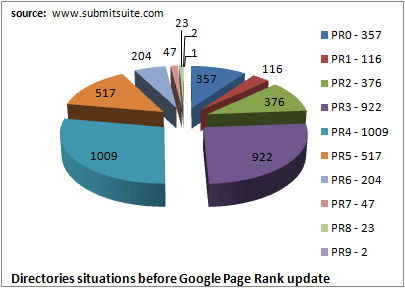
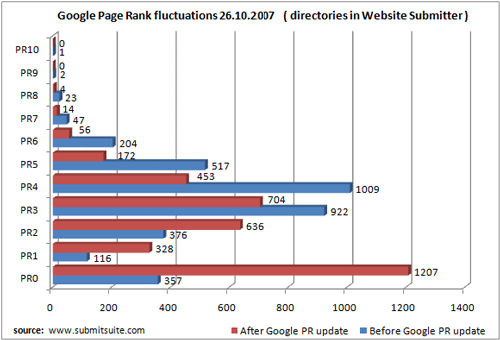
the analyze on 3574 directories ( contained in Website Submitter ) and found the results quite amazing, a big downgrade on each level of PR distribution.
Source
Friday, 25 July 2008
search engine optimization and marketing industry related keywords with their definitions
Algorithm
An algorithm is a set of finite, ordered steps for solving a mathematical problem. Each Search Engine uses a proprietary algorithm set to calculate the relevance of its indexed web pages to your particular Query. The result of this process is a list of sites ranked in the order that the search engine deemed most relevant. Search engine algorithms are closely guarded in order to prevent exploitation of algorithmic results. Search algorithms are also changed frequently to incorporate new data and improve relevancy.
Algorithmic Results
Algorithmic results are the ranked listings search engines provide in response to a Query. They are often referred to as Organic Listings in contrast to Paid Listings because their rank is based on relevancy rather than advertising revenue paid to the search engine. However, paid listings do appear alongside algorithmic results in many search engines, provided they are relevant. Improving a website’s unpaid algorithmic results is known as Natural Search Engine Optimization.
Alt Tag/Alt Text
An alt tag is the HTML text that appears while an image is loading or when a cursor is positioned over an image. Alt text is useful in Search Engine Optimization because it can include keywords that a search engine looks for in response to a query.
Analytics
Analytics refers to all the technology, programming, and data used in Search Engine Marketing to analyze a website’s performance or the success of an Internet marketing campaign.
Anchor Text
Also known as link text, anchor text is the visible, clickable text between the HTML anchor and tags. Clicking on anchor text activates a Hyperlink to another web site. Anchor text is very important in Search Engine Optimization because search engine algorithms consider the Hyperlink keywords as relevant to the Landing Page.
Backlinks
Also known as back link, backward link, or inbound links, backlinks are all of the links on other websites that direct the users who click on them to your site. Backlinks can significantly improve your site’s search rankings, particularly if they contain Anchor Text keywords relevant to your site and are located on sites with high Page Rank.
Banned
Also known as delisted or blacklisted, a banned site is a URL that has been removed from a search engine’s Index, typically for engaging in Black Hat SEO. Banned sites are ignored by search engines.
Banner Ad
A banner ad is a rectangular graphic advertisement. Banner ads are one of the commonest forms of online advertising. Their sizes vary, but most measure 468 pixels wide by 60 pixels high. Clicking on a banner ad will direct you to the advertiser’s website or a designated Landing Page.
Black Hat SEO
Black hat SEO is the term used for unethical or deceptive optimization techniques. This includes Spam, Cloaking, or violating search engine rules in any way. If a search engine discovers a site engaging in black hat SEO it will remove that site from its Index.
Blacklisted
Also known as banned or delisted, a blacklisted site is a URL that has been removed from a search engine’s Index, typically for engaging in Black Hat SEO. Blacklisted sites are ignored by search engines.
Broken Link
Also known as a dead link, a broken link is a link that no longer points to an active destination or Landing Page. Search engines dislike broken links. Keeping all of your site’s links active is an important part of ongoing optimization.
Click Fraud
Click Fraud is the illegal practice of manipulating Cost-Per-Click (CPC) or Pay-Per-Click (PPC) revenue sharing agreements. There are numerous types of click fraud, but in a typical scenario the webmaster of a site that earns money from each click of the advertising links it publishes pays individuals a small fee to click those links. Companies thus pay for advertising to clients who had no intention of buying from them. Some companies have filed class action lawsuits alleging that ad publishers such as Google and Yahoo! have failed to aggressively confront click fraud because they benefit from increased CPC revenue.
Click-Through
Click-through refers to a single instance of a user clicking on an advertising link or site listing and moving to a Landing Page. A higher Click-Through Rate (CTR) is one of the primary goals of Search Engine Optimization.
Click-Through Rate (CTR)
Click-through rate is the percentage of users who click on an advertising link or search engine site listing out of the total number of people who see it, i.e. four click-throughs out of ten views is a 40% CTR.
Cloaking
Cloaking is the presentation of alternative pages to a search engine Spider so that it will record different content for a URL than what a human browser would see. Cloaking is typically done to achieve a higher search engine position or to trick users into visiting a site. In such cases cloaking is considered to be Black Hat SEO and the offending URL could be Blacklisted. However, cloaking is sometimes used to deliver personalized content based on a browser’s IP address and/or user-agent HTTP header. Such cloaking should only be practiced with a search engine’s knowledge or it could be construed as black hat cloaking.
Contextual Link Inventory (CLI)
Search engines/advertising networks use their contextual link inventory to match keyword-relevant text-link advertising with site content. CLI is generated based on listings of website pages with content that the ad-server deems a relevant keyword match. Ad networks further refine CLI relevancy by monitoring the Click-Through Rate of the displayed ads.
Conversion
Conversion is the term used for any significant action a user takes while visiting a site, i.e. making a purchase, requesting information, or registering for an account.
Conversion Analytics
Conversion analytics is a branch of Analytics concerned specifically with conversion-related information from organic and paid search engine traffic, such as the keywords converts used in their queries, the type of conversion that resulted, landing page paths, search engine used, etc.
Conversion Rate
Conversion rate is the next step up from Click-Through Rate. It’s the percentage of all site visitors who “convert” (make a purchase, register, request information, etc.). If three users buy products and one user requests a catalogue out of ten daily visitors, a site’s conversion rate is 40%.
Cost-Per-Acquisition (CPA)
Cost-per-acquisition (CPA) is a return on investment model in which return is measured by dividing total click/marketing costs by the number of Conversions achieved. Total acquisition costs ÷ number of conversions = CPA. CPA is also used as a synonym for Cost-Per-Action.
Cost-Per-Action (CPA)
In a cost-per-action advertising revenue system, advertisers are charged a Conversion-based fee, i.e. each time a user buys a product, opens an account, or requests a free trial. CPA is also known as cost-per-acquisition, though the term cost-per-acquisition can be confusing because it also refers to a return on investment model.
Cost-Per-Click (CPC)
Also known as pay-per-click or pay-for-performance, cost-per-click is an advertising revenue system used by search engines and ad networks in which advertising companies pay an agreed amount for each click of their ads. This Click-Through Rate-based payment structure is considered by some advertisers to be more cost-effective than the Cost-Per-Thousand payment structure, but it can at times lead to Click Fraud.
Cost-Per-Thousand (CPM)
Also known as cost-per-impression or CPM for cost-per-mille (mille is the Latin word for thousand), cost-per-thousand is an advertising revenue system used by search engines and ad networks in which advertising companies pay an agreed amount for every 1,000 users who see their ads, regardless of whether a click-through or conversion is achieved. CPM is typically used for Banner Ad sales, while Cost-Per-Click is typically used for text link advertising.
Crawler
Also known as Spider or Robot, a crawler is a search engine program that “crawls” the web, collecting data, following links, making copies of new and updated sites, and storing URLs in the search engine’s Index. This allows search engines to provide faster and more up-to-date listings.
Delisted
Also known as banned or blacklisted, a delisted site is a URL that has been removed from a search engine’s Index, typically for engaging in Black Hat SEO. Delisted sites are ignored by search engines.
Description Tag
Also known as a meta description tag, a description tag is a short HTML paragraph that provides search engines with a description of a page’s content for search engine Index purposes. The description tag is not displayed on the website itself, and may or may not be displayed in the search engine’s listing for that site. Search engines are now giving less importance to description tags in lieu of actual page content.
Directory
A directory is an Index of websites compiled by people rather than a Crawler. Directories can be general or divided into specific categories and subcategories. A directory’s servers provide relevant lists of registered sites in response to user queries. Directory Registration is thus an important method for building inbound links and improving SEO performance. However, the decision to include a site and its directory rank or categorization is determined by directory editors rather than an Algorithm. Some directories accept free submissions while others require payment for listing. The most popular directories include Yahoo!, The Open Directory Project, and LookSmart.
Doorway Page
Also known as a gateway page or jump page, a doorway page is a URL with minimal content designed to rank highly for a specific keyword and redirect visitors to a homepage or designated Landing Page. Some search engines frown on doorway pages as a softer form of Cloaking or Spam. However, doorway pages may be legitimate landing pages designed to measure the success of a promotional campaign, and they are commonly allowed in Paid Listings.
Dynamic Content
Dynamic content is web content such as Search Engine Results Pages (SERPS) that are generated or changed based on database information or user activity. Web pages that remain the same for all visitors in every context contain “static content.” Many e-commerce sites create dynamic content based on purchase history and other factors. Search engines have a difficult time indexing dynamic content if the page includes a session ID number, and will typically ignore URLs that contain the variable “?”.Search engines will punish sites that use deceptive or invasive means to create dynamic content.
Flash Optimization
Flash is a vector graphics-based animation program developed by Macromedia. Most corporate sites feature Flash movies/animation, yet because search engine Crawlers were designed to index HTML text, sites that favor Flash over text are difficult or even impossible for crawlers to read. Flash Optimization is the process of reworking the Flash movie and surrounding HTML code to be more “crawlable” for Search Engines.
Gateway Page
Also known as a doorway page or jump page, a gateway page is a URL with minimal content designed to rank highly for a specific keyword and redirect visitors to a homepage or designated Landing Page. Some search engines frown on gateway pages as a softer form of Cloaking or Spam. However, gateway pages may be legitimate landing pages designed to measure the success of a promotional campaign, and they are commonly allowed in Paid Listings.
Geographical Targeting
Geographical targeting is the focusing of Search Engine Marketing on states, counties, cities and neighborhoods that are important to a company’s business. One basic aspect of geographical targeting is adding the names of relevant cities or streets to a site’s keywords, i.e. Hyde Street Chicago apartments. Another important element of geo-targeting is increasing your site’s presence on Local Search engines.
Geographic Segmentation
Geographic segmentation is the use of Analytics to categorize a site’s web traffic by the physical locations from which it originated.
Google AdSense
Google AdSense is an ad-serving program operated by Google that provides relevant text, image, and video-based advertisements to enrolled site owners. Advertisers register via Google AdWords and pay for ads on a Pay-Per-Click, Cost-Per-Thousand or Cost-Per-Action basis. This revenue is shared with Google AdSense host sites, typically on a PPC basis (which sometimes leads to Click Fraud). Google uses its search Algorithms and Contextual Link Inventory to display the most appropriate ads based on site content, Query relevancy, ad “quality scores,” and other factors.
Google AdWords
Google AdWords is the Keyword Submission program that determines the advertising rates and keywords used in the Google AdSense program. Advertisers bid on the keywords that are relevant to their businesses. Ranked ads then appear as sponsored links on Google Search Engine Results Pages (SERPS) and Google AdSense host sites.
Graphical Search Inventory (GSI)
Graphical Search Inventory is the visual equivalent of Contextual Link Inventory. GSI is non-text-based advertising such as Banner Ads, pop-up ads, browser toolbars, animation, sound, video and other media that is synchronized to relevant Keyword queries.
Gray Hat SEO
Gray hat SEO refers to Search Engine Optimization strategies that fall in between Black Hat SEO and White Hat SEO. Gray hat SEO techniques can be legitimate in some cases and illegitimate in others. Such techniques include Doorway Pages, Gateway Pages, Cloaking and duplicate content.
Hidden Text
Hidden text is a generally obsolete form of Black Hat SEO in which pages are filled with a large amount of text that is the same color as the background, rendering keywords invisible to the human eye but detectable to a search engine Crawler. Multiple Title Tags or HTML comments are alternative hidden text techniques. Hidden text is easily detectable by search engines and will result in Blacklisting or reduced Rank.
Hit
Hit is a somewhat misleading measure of traffic to a web site. One hit is recorded for each file request in a web server’s access log. If a user visits a page with four images, one hit will be recorded for each graphic image file plus another for the page’s HTML file. A better measure of traffic volume is the number of pages/HTML files accessed.
HTML
The acronym HTML stands for HyperText Markup Language, the authoring language used to create pages on the World Wide Web. HTML is a set of codes or HTML tags that provide a web browser with directions on how to structure a web page’s information and features.
Hyperlink
Also known as link or HTML link, a hyperlink is an image or portion of text that when clicked on by a user opens another web page or jumps the browser to a different portion of the current page. Inbound Links with keyword-relevant Link Text are an important part of Search Engine Optimization Strategy.
Index
An index is a Search Engine’s database. It contains all of the information that a Crawler has identified, particularly copies of World Wide Web pages. When a user performs a Query, the search engine uses its indexed pages and Algorithm set to provide a ranked list of the most relevant pages. In the case of a Directory, the index consists of titles and summaries of registered sites that have been categorized by the directory’s editors.
Inbound Links
Also known as back link, backward link, or backlinks, inbound links are all of the links on other websites that direct the users who click on them to your site. Inbound links can significantly improve your site’s search rankings, particularly if they contain Anchor Text keywords relevant to your site and are located on sites with high Page Rank.
Impression
Also known as a page view, an impression is a single instance of an online advertisement being displayed. Search engines and ad networks use impression statistics to charge advertisers on a Cost-Per-Thousand (CPM) basis.
Internet Marketing
On a fundamental level, Internet marketing is using the Internet to advertise, communicate and sell goods and services. On an advanced level, Internet marketing is known as Search Engine Optimization (SEO), which is the use of targeted keywords, crawler-friendly site architecture, Search Engine Submissions and a well-developed link network to improve a site’s Position, Page Rank and Click-Through Rate.
Internet Marketing Consultant
Also known as SEO professionals or SEO specialists, Internet marketing consultants use their knowledge of Search Engine Optimization Strategy to improve their clients’ Position and Page Rank.
Internet Promotion
Also known as search engine promotion, website marketing or website promotion, Internet promotion refers to all methods employed by a company or individual to promote a website and increase its Position and Page Rank.
Keyword
Also known as search terms or query terms, keywords are the word(s) or phrase(s) a user enters into a search engine’s Query box. A Search Engine Results Page (SERP) ranks indexed sites according to how relevant the Search Engine deems them to the searched keywords. One of the most important SEO Strategies companies can employ is to optimize their site pages with content that contains targeted keywords relevant to their products or industry.
Keyword Marketing
Keyword marketing is the use of keyword-optimized content and keyword-specific Link Text to emphasize a site’s relevancy to those terms and thereby increase Rank for related web queries. Keyword marketing can also be done through keyword-based ad programs such as Google AdSense. Keyword marketing is an essential component of Search Engine Optimization.
Keyword Submission
Keyword submission is an all-inclusive term for the keyword research/selection, bid cost assessment and budgeting that companies undertake to begin Pay-Per-Click keyword campaigns with advertising networks such as Google AdWords, Yahoo! Sponsored Search and Microsoft AdCenter.
Landing Page
The landing page is the page on which a visitor “lands” after clicking a search engine listing, email link, Banner Ad, Cost-Per-Click ad, or other ad/link. The landing page can be a site’s homepage, but is usually a page designed to appeal to users who Click-Through a specific ad or link. Landing pages are also used to monitor site traffic and measure an advertising campaign’s success. Well-designed landing pages that are relevant to a user’s keyword query will improve Conversion Rates and play a critical role in Search Engine Marketing.
Link
Also known as hyperlink or HTML link, a link is an image or portion of text that when clicked on by a user opens another web page or jumps the browser to a different portion of the current page. Inbound Links with keyword-relevant Link Text are an important part of Search Engine Optimization Strategy.
Link Baiting
Link baiting is the creation of content that incites users to link to your page from another website. The types of link bait vary tremendously, but they include highly informative articles or news stories, useful resources and sometimes controversial or sensationalistic content. Link baiting is a White Hat SEO technique used to help a site improve its Link Popularity and Page Rank. Some sites use link baiting as the centerpiece of a Website Marketing campaign.
Link Exchange
A link exchange is a quid pro quo arrangement or reciprocal link exchange between two sites. Reciprocal links usually lead to the home page of the associate site.
Link Farm
A link farm is a webpage or group of webpages that exist solely to increase the number of Backlinks in a site’s link network. A link farm is meant to increase a site’s PageRank or popularity and thus improve its search engine Position. However, link farms are considered a form of Spam and sites that rely on them are penalized by search engines.
Link Popularity
Link popularity is the measure of how popular a webpage is by the number of Backlinks it has. However, link popularity is not solely a matter of quantity. Page Rank is achieved when Backlinks are located on reputable, relevant sites rather than so-called Link Farms. Most search engines use link popularity as a factor in their Algorithmic Results.
Link Text
Also known as anchor text, link text is the visible, clickable text between the HTML anchor andtags. Clicking on link text activates a Hyperlink to another web site. Link text is very important in Search Engine Optimization because search engine algorithms consider the hyperlink keywords as relevant to the Landing Page.
Listings
Listings are the indexed sites that appear in ranked order on a Search Engine Results Page in response to a user Query.
Local Search
Local search refers to both the addition of geographical keywords (cities, streets, etc.) to Search Terms and the use of Yellow Pages-type Search Engines such as Google Maps, Yahoo! Local and AskCity to find business services in a particular zip code. Search Engine Placement Services use local SEO to help traditional “brick and mortar businesses” connect with customers in their community.
Marketing Analytics
Marketing analytics is a branch of Analytics concerned specifically with marketing-related information from organic and paid search engine traffic, such as Unique Visitors, keyword-generated sales, Cost-Per-Click advertising, Click Fraud, Search Engine Marketing, etc.
Meta Description Tag
Also known as a description Tag, a meta description tag is a short HTML paragraph that provides search engines with a description of a page’s content for search engine Index purposes. The meta description tag is not displayed on the website itself, and may or may not be displayed in the search engine’s listing for that site. Search engines are now giving less importance to meta description tags in lieu of actual page content.
Meta Keywords Tag
A meta keywords tag provides search engines with a list of keywords that are relevant to a webpage. This can improve search engine Rank for a page by ensuring it’s properly indexed. However, search engines are now giving less importance to meta keywords tags in lieu of actual page content.
Meta Robots Tag
A meta robots tag (named for a search engine Crawler or Robot) lets page authors prevent their webpages from being added to a search engine’s Index. Alternatives to a meta robots tag are Robots.txt files and password protection.
Meta Search Engine
A meta search engine derives its listings by running user queries through multiple other search engines and then summarizing the results. A meta search engine does not maintain its own Index. Listings are displayed by meta search engines either in aggregate or categorized by search engine source. An example of a meta search engine is Dogpile.com.
Meta Tags
Meta tags are HTML tags placed in a webpage that contain information for Crawlers and web browsers. Types of meta tag information include page descriptions (Description Tag), page-relevant keywords (Meta Keywords Tag), whether a page can be indexed (Meta Robots Tag), copyright, page refresh dates and redirection instructions.
Natural Listings (or Natural Optimization)
Also known as organic listings, natural listings are webpage listings that appear on a Search Engine Results Page solely because the search engine Algorithm deems them relevant to the Query. Natural listings can contain Paid Listings, but only if they fulfill the same requirements as natural listings. The best way to improve a site’s natural listing Position is through Natural Search Engine Optimization.
Natural Search Engine Optimization
Also known as natural optimization, organic search engine optimization or white hat SEO, natural search engine optimization is the use of keyword-focused copy and tags, Crawler-friendly site architecture, Search Engine Submissions and a quality Backlinks network to improve a site’s Position, Page Rank and Click-Through Rate. Because about 80% of web users look at Natural Listings first, natural SEO offers a much greater chance of long-term business success than Paid Listings or Pay-Per-Click ad campaigns.
Optimization Services
Also known as Internet promotion, site optimization, or search engine placement service, optimization services are all of the methods a Search Engine Optimization Company uses to improve a site’s Position and Page Rank and increase its Click-Through Rate and Conversion Rate.
Organic Listings (or Organic Optimization)
Also known as natural listings, organic listings are webpage listings that appear on a Search Engine Results Page solely because the search engine Algorithm deems them relevant to the Query. Organic listings can contain Paid Listings, but only if they fulfill the same requirements as organic listings. The best way to improve a site’s organic listing Position is through Natural Search Engine Optimization.
Outbound Links
Outbound links are all links from a particular webpage that lead to other pages, including pages in the same domain. An excessive number of outbound links can damage a site’s Search Engine Positioning because a Spider may perceive it as a Link Farm.
Page Rank (or PR)
PageRank is a link analysis algorithm developed by Google founders Larry Page and Sergey Brin. A number from one (lowest) to ten (highest) is assigned to a webpage as a measure of its importance, specifically the likelihood that a user will arrive at that page by randomly clicking Links. PageRank is not the same thing as Rank.
Paid Inclusion
Paid inclusion is an advertising program offered by some search engines in which a page is guaranteed inclusion in the Index in exchange for a fee. Unlike Paid Placement, the rank of paid inclusion pages is determined solely by the search engine Algorithm. Paid inclusion sites may or may not be labeled as advertisements depending on Search Engine policy.
Paid Listings
Paid Listings, as opposed to Natural Listings or Organic Listings, are sites that appear on a Results Page because money was paid to the search engine for inclusion and/or position. Paid listings is used as an all-inclusive term for the practices of Paid Inclusion and Paid Placement.
Paid Placement
Paid placement is a program in which advertisers’ listings are guaranteed to appear on a Results Page when particular Keywords are searched. The ranking of paid placement listings is determined by competitive bidding. Unlike Paid Inclusion listings, paid placement listings are usually displayed separately from Natural Listings and are labeled as advertisements or sponsored links. Google and Yahoo! Search Marketing (formerly Overture) are two of the largest paid placement search networks.
Pay-Per-Click (PPC)
Also known as cost-per-click or pay-for-performance, pay-per-click is an advertising revenue system used by search engines and ad networks in which advertising companies pay an agreed amount for each click of their ads. This Click-Through Rate-based payment structure is considered by some advertisers to be more cost-effective than the Cost-Per-Thousand payment structure, but it has at times led to Click Fraud.
Position
Also known as rank, position is the place a website occupies relative to the first listing on an Algorithmic Results page in response to a Keyword query. The first page displays Listings in the one through ten positions, the second page eleven through twenty, etc. Businesses trying to get their site into a top ten position will often employ a Professional Search Engine Optimization company. Consumer studies have shown that most search engine users click only on sites that occupy the top ten positions.
Position Reporting
Position reporting is the monitoring of daily changes in search engine Position for indexed URLs that have been optimized for specific keywords by a Search Engine Optimization Company. Position reporting is also used to generate a Search Engine Ranking Report.
Professional Search Engine Optimization
Professional search engine optimization is the modification of a website by an SEO company in order to increase its Position and Page Rank and improve its Click-Through Rate and Conversion Rate.
Query
A query is a question or instance of questioning. A search engine query is a user’s request for the information (i.e. webpages) in a search engine’s Index that is most relevant to a Keyword or set of Search Terms. Query is sometimes used to mean the actual keywords a user enters in a search box.
Rank
Also known as position, rank is the place a website occupies relative to the first listing on an Algorithmic Results page in response to a Keyword query. The first page displays Listings in the one through ten positions, the second page eleven through twenty, etc. Businesses trying to get their site into a top-ten rank will often employ a Professional Search Engine Optimization company. Consumer studies have shown that most search engine users click only on sites that occupy a top-ten rank.
Reciprocal Link Exchange
A reciprocal link exchange is a quid pro quo arrangement or link exchange between two sites. Reciprocal links usually lead to the home page of the associate site.
Registration
Also known as search engine registration or search engine submission, registration is the submission of a URL to a Directory or Search Engine for inclusion in its Index. Registration is usually free but can also require payment. Registration is a basic but important part of Search Engine Optimization.
Results Page
Also known as search engine results page, the results page is the collection of ranked Listings displayed in response to a search engine Query.
Robot
Also known as Crawler or Spider, a robot is a search engine program that “crawls” the web, collecting data, following links, making copies of new and updated sites, and storing URLs in the search engine’s Index. This allows search engines to provide faster and more up-to-date listings.
Robots.txt
Also known as robots exclusion protocol, Robots.txt is a text file stored in a site’s root directory that tells a search engine Crawler which site pages and sub-folders should not be included in the search engine Index. However, there is no guarantee that a Crawler will comply with this request. Robots.txt is an alternative to a Meta Robots Tag or password protection.
SEO Professional
Also known as Internet marketing consultant or SEO specialist, SEO professionals use their knowledge of Search Engine Optimization Strategy to improve their clients’ Position and Page Rank.
SEO Services
SEO services are all of the tools used by a Professional Search Engine Optimization company, including Analytics and Keyword Marketing.
SEO Specialist
Also known as Internet marketing consultant or SEO professional, SEO specialists use their knowledge of Search Engine Optimization Strategy to improve their clients’ Position and Page Rank.
SEO Strategies
SEO strategies are the techniques used in Search Engine Optimization to improve a site’s Position and Page Rank and increase its Click-Through Rate. A few SEO strategies are keyword research and content writing, optimized HTML code, and improved Geographical Targeting.
Search Engine
A search engine is a website that enables users to Query an Index of stored webpages gathered by a Crawler for information relevant to specific criteria expressed via a Keyword or Search Terms. The Rank of information/websites on the corresponding Search Engine Results Pages is determined by relevancy as measured by the search engine’s Algorithm and/or payment made to the search engine by indexed sites. Sites ranked solely by relevancy are known as Natural Listings or Organic Listings in contrast to Paid Listings.
Search Engine Marketing (SEM)
Search engine marketing is an inclusive term for all techniques used to market a website via search engines, including Pay-Per-Click advertising and Natural Search Engine Optimization.
Search Engine Marketing Professional Organization (SEMPO)
The Search Engine Marketing Professional Organization (SEMPO) is a non-profit professional association founded in 2003 to increase awareness of the benefits of search engine marketing and provide educational resources to members and consumers.
Search Engine Optimization (SEO)
Search engine optimization is the modification of a website for the purpose of improving its natural Rank on Search Engine Results Pages. This is done through a combination of SEO strategies such as directory and search engine Submission, website optimization, content writing and improved Link quality. Please see our SEO services for details.
Search Engine Optimization Company (SEO Company)
A search engine optimization company employs SEO Strategies to improve a website’s Search Engine Placement.
Search Engine Optimization Consultants
Also known as SEO professionals or SEO specialists, search engine optimization consultants analyze a website’s Position and Keyword strength and offer solutions for improvement.
Search Engine Optimization Software Systems
Search engine optimization software systems enable marketers to generate site data and automatically customize Submission schedules. However, automated submissions should generally be avoided in favor of submissions catered to each search engine’s rules.
Search Engine Optimization Strategy
Search engine optimization strategy refers to the specific optimization plan an SEO company employs for the site promotion of an individual client.
Search Engine Placement
Search engine placement means the tactics used by Site Optimization firms to improve their clients’ Rank. The term search engine placement is sometimes used to mean the Position of a website on a Results Page.
Search Engine Placement Services
Also known as Internet promotion, optimization services or site optimization, search engine placement services are all of the methods a Search Engine Optimization Company uses to improve a site’s Position and Page Rank and increase its Click-Through Rate and Conversion Rate.
Search Engine Positioning
The term search engine positioning can be used in two different ways. The first is to describe the ordering process of indexed websites being ranked by a search engine Algorithm in response to a Query. The second refers to the use of Search Engine Optimization to achieve a higher search engine Position.
Search Engine Promotion
Also known as Internet promotion, website marketing or website promotion, Internet promotion refers to all methods employed by a company or individual to promote a website and increase its Position and PageRank.
Search Engine Ranking Report
A search engine ranking report is a monthly, weekly or daily report of the Position of a company’s website Listing in relation to their top Keywords. Position Reporting enables companies to monitor the success of an SEO strategy or Cost-Per-Click advertising campaign.
Search Engine Registration
Also known as search engine submission or web submission, search engine registration is the submission of a URL to a Directory or Search Engine for inclusion in its Index. Registration is usually free but can also require payment. Search engine registration is a basic but important part of Search Engine Optimization.
Search Engine Results Page (SERPs)
Also known as a results page, the search engine results page is the collection of ranked Listings displayed in response to a search engine Query.
Search Engine Submission
Also known as search engine registration or web submission, search engine submission is the submission of a URL to a Directory or Search Engine for inclusion in its Index. Registration is usually free but can also require payment. Search engine submission is a basic but important part of Search Engine Optimization.
Search Terms
Also known as keywords or query terms, search terms are the word(s) or phrase(s) a user enters into a search engine’s Query box. A Search Engine Results Page (SERP) ranks indexed sites according to how relevant the Search Engine deems them to the search terms that were queried. One of the most important SEO Strategies companies can employ is to optimize their site pages with content that contains targeted search terms relevant to their products or industry.
Shopping Search
Shopping search engines or search engines with a shopping feature (such as Google Product Search, formerly known as Froogle) allow users to comparison shop by providing lists of sellers and prices in response to a product Query. Some shopping search sites require Paid Inclusion or offer Paid Placement.
Site Optimization
Also known as Internet promotion, optimization services or search engine placement service, site optimization refers to all of the methods a Search Engine Optimization Company uses to improve a site’s Position and Page Rank and increase its Click-Through Rate and Conversion Rate.
Spam
Spam refers to any and all Search Engine Marketing techniques that violate search engine guidelines or attempt to gain increased Rank for a site using content that is irrelevant, deceptive or of little value to users. Types of spam include Hidden Text, content that contains nonsensical Keyword repetition, deceptive Cloaking or numerous Doorway Pages that redirect users to the same Landing Page. If a search engine detects spamming the offending site will be Blacklisted or lose Position. Spam is a Black Hat SEO technique.
Spider
Also known as Crawler or Robot, a spider is a search engine program that “crawls” the web, collecting data, following links, making copies of new and updated sites, and storing URLs in the search engine’s Index. This allows search engines to provide faster and more up-to-date listings.
Submission
Also known as search engine registration or search engine submission, submission is the providing of a URL to a Directory or Search Engine for inclusion in its Index. Submission is usually free but can also require payment. Submission is a basic but important part of Search Engine Optimization.
Title Tags
A title tag is an HTML tag which contains a sentence of text describing the contents of its associated webpage. Title tags are a very important part of Search Engine Optimization because they are frequently used as the text links that lead to sites from a search engine’s Results Page. The best title tags contain strategic keywords that will help a site be indexed properly and appeal to human search engine users.
Three-Way Link Exchange
A three-way link exchange is a Reciprocal Link Exchange established between three domains. However, unlike a two-way link exchange, not all three sites link to each other. Page A links to Page B and Page B links to Page C and Page C links to Page A. Page B does not post a reciprocal link to Page A and Page C does not post a reciprocal link to Page B. Three-way link exchanges are used by owners of multiple websites to increase the Link Popularity and Page Rank of new or smaller sites.
Unique Visitor
Unique visitor is a web traffic measuring term which means the registering of at least one hit on one page of a web site from a unique IP address during a specified report period (typically anywhere from twenty-four hours to a month). A subsequent hit(s) by the same IP address is not counted as a unique visitor during that report period. Unique visitor count can be an effective way of measuring the success of an SEO strategy.
Web Analytics
Web analytics is a branch of Analytics that uses web traffic records to study the behavior of website visitors. Data such as Unique Visitors, Hits, page views, and the connection between Landing Pages and Conversion Rates are used to improve a website or marketing campaign.
Website Marketing
Also known as Internet marketing, website marketing is using the Internet to advertise, communicate and sell goods and services. On an advanced level, website marketing is known as Search Engine Optimization (SEO), which is the use of targeted keywords, crawler-friendly site architecture, Search Engine Submissions and a well-developed link network to improve a site’s Position, Page Rank and Click-Through Rate.
Website Optimization
Also known as search engine optimization, website optimization is the modification of a website for the purpose of improving its natural Rank on Search Engine Results Pages. This is done through a combination of optimization strategies such as directory and search engine Submission, Keyword Marketing and improved Link quality.
Website Promotion
Website promotion refers to the marketing aspects of Search Engine Optimization, such as Keyword Submission, Paid Inclusion, and other techniques to increase a site’s exposure.
Website Promotion Services
Also known as search engine marketing, website promotion services is an inclusive term for all techniques used to market a website via search engines, including Pay-Per-Click advertising and Natural Search Engine Optimization.
Website Submission
Also known as search engine registration or search engine submission, website submission is the submission of a URL to a Directory or Search Engine for inclusion in its Index. Registration is usually free but can also require payment. Website submission is a basic but important part of Search Engine Optimization.
White Hat SEO
Also known as natural search engine optimization or organic search engine optimization, white hat SEO is the legitimate use of keyword-focused copy and tags, Crawler-friendly site architecture, Search Engine Submissions and a quality Backlinks network to improve a site’s Position, Page Rank and Click-Through Rate. White hat SEO does not involve the use of Cloaking, Spam or any other Black Hat SEO techniques.
XML
XML is an acronym for Extensible Markup Language, a simple and flexible text-based programming language used in conjunction with HTML. XML is useful for data exchange and the creation of customized tags.
XML Feed
An XML feed is a form of Paid Inclusion or Search Engine Submission in which an XML document is used to provide a search engine with information about multiple web pages. An XML feed is particularly useful for multimedia sites or database sites that draw a variety of relevant search queries.
An algorithm is a set of finite, ordered steps for solving a mathematical problem. Each Search Engine uses a proprietary algorithm set to calculate the relevance of its indexed web pages to your particular Query. The result of this process is a list of sites ranked in the order that the search engine deemed most relevant. Search engine algorithms are closely guarded in order to prevent exploitation of algorithmic results. Search algorithms are also changed frequently to incorporate new data and improve relevancy.
Algorithmic Results
Algorithmic results are the ranked listings search engines provide in response to a Query. They are often referred to as Organic Listings in contrast to Paid Listings because their rank is based on relevancy rather than advertising revenue paid to the search engine. However, paid listings do appear alongside algorithmic results in many search engines, provided they are relevant. Improving a website’s unpaid algorithmic results is known as Natural Search Engine Optimization.
Alt Tag/Alt Text
An alt tag is the HTML text that appears while an image is loading or when a cursor is positioned over an image. Alt text is useful in Search Engine Optimization because it can include keywords that a search engine looks for in response to a query.
Analytics
Analytics refers to all the technology, programming, and data used in Search Engine Marketing to analyze a website’s performance or the success of an Internet marketing campaign.
Anchor Text
Also known as link text, anchor text is the visible, clickable text between the HTML anchor and tags. Clicking on anchor text activates a Hyperlink to another web site. Anchor text is very important in Search Engine Optimization because search engine algorithms consider the Hyperlink keywords as relevant to the Landing Page.
Backlinks
Also known as back link, backward link, or inbound links, backlinks are all of the links on other websites that direct the users who click on them to your site. Backlinks can significantly improve your site’s search rankings, particularly if they contain Anchor Text keywords relevant to your site and are located on sites with high Page Rank.
Banned
Also known as delisted or blacklisted, a banned site is a URL that has been removed from a search engine’s Index, typically for engaging in Black Hat SEO. Banned sites are ignored by search engines.
Banner Ad
A banner ad is a rectangular graphic advertisement. Banner ads are one of the commonest forms of online advertising. Their sizes vary, but most measure 468 pixels wide by 60 pixels high. Clicking on a banner ad will direct you to the advertiser’s website or a designated Landing Page.
Black Hat SEO
Black hat SEO is the term used for unethical or deceptive optimization techniques. This includes Spam, Cloaking, or violating search engine rules in any way. If a search engine discovers a site engaging in black hat SEO it will remove that site from its Index.
Blacklisted
Also known as banned or delisted, a blacklisted site is a URL that has been removed from a search engine’s Index, typically for engaging in Black Hat SEO. Blacklisted sites are ignored by search engines.
Broken Link
Also known as a dead link, a broken link is a link that no longer points to an active destination or Landing Page. Search engines dislike broken links. Keeping all of your site’s links active is an important part of ongoing optimization.
Click Fraud
Click Fraud is the illegal practice of manipulating Cost-Per-Click (CPC) or Pay-Per-Click (PPC) revenue sharing agreements. There are numerous types of click fraud, but in a typical scenario the webmaster of a site that earns money from each click of the advertising links it publishes pays individuals a small fee to click those links. Companies thus pay for advertising to clients who had no intention of buying from them. Some companies have filed class action lawsuits alleging that ad publishers such as Google and Yahoo! have failed to aggressively confront click fraud because they benefit from increased CPC revenue.
Click-Through
Click-through refers to a single instance of a user clicking on an advertising link or site listing and moving to a Landing Page. A higher Click-Through Rate (CTR) is one of the primary goals of Search Engine Optimization.
Click-Through Rate (CTR)
Click-through rate is the percentage of users who click on an advertising link or search engine site listing out of the total number of people who see it, i.e. four click-throughs out of ten views is a 40% CTR.
Cloaking
Cloaking is the presentation of alternative pages to a search engine Spider so that it will record different content for a URL than what a human browser would see. Cloaking is typically done to achieve a higher search engine position or to trick users into visiting a site. In such cases cloaking is considered to be Black Hat SEO and the offending URL could be Blacklisted. However, cloaking is sometimes used to deliver personalized content based on a browser’s IP address and/or user-agent HTTP header. Such cloaking should only be practiced with a search engine’s knowledge or it could be construed as black hat cloaking.
Contextual Link Inventory (CLI)
Search engines/advertising networks use their contextual link inventory to match keyword-relevant text-link advertising with site content. CLI is generated based on listings of website pages with content that the ad-server deems a relevant keyword match. Ad networks further refine CLI relevancy by monitoring the Click-Through Rate of the displayed ads.
Conversion
Conversion is the term used for any significant action a user takes while visiting a site, i.e. making a purchase, requesting information, or registering for an account.
Conversion Analytics
Conversion analytics is a branch of Analytics concerned specifically with conversion-related information from organic and paid search engine traffic, such as the keywords converts used in their queries, the type of conversion that resulted, landing page paths, search engine used, etc.
Conversion Rate
Conversion rate is the next step up from Click-Through Rate. It’s the percentage of all site visitors who “convert” (make a purchase, register, request information, etc.). If three users buy products and one user requests a catalogue out of ten daily visitors, a site’s conversion rate is 40%.
Cost-Per-Acquisition (CPA)
Cost-per-acquisition (CPA) is a return on investment model in which return is measured by dividing total click/marketing costs by the number of Conversions achieved. Total acquisition costs ÷ number of conversions = CPA. CPA is also used as a synonym for Cost-Per-Action.
Cost-Per-Action (CPA)
In a cost-per-action advertising revenue system, advertisers are charged a Conversion-based fee, i.e. each time a user buys a product, opens an account, or requests a free trial. CPA is also known as cost-per-acquisition, though the term cost-per-acquisition can be confusing because it also refers to a return on investment model.
Cost-Per-Click (CPC)
Also known as pay-per-click or pay-for-performance, cost-per-click is an advertising revenue system used by search engines and ad networks in which advertising companies pay an agreed amount for each click of their ads. This Click-Through Rate-based payment structure is considered by some advertisers to be more cost-effective than the Cost-Per-Thousand payment structure, but it can at times lead to Click Fraud.
Cost-Per-Thousand (CPM)
Also known as cost-per-impression or CPM for cost-per-mille (mille is the Latin word for thousand), cost-per-thousand is an advertising revenue system used by search engines and ad networks in which advertising companies pay an agreed amount for every 1,000 users who see their ads, regardless of whether a click-through or conversion is achieved. CPM is typically used for Banner Ad sales, while Cost-Per-Click is typically used for text link advertising.
Crawler
Also known as Spider or Robot, a crawler is a search engine program that “crawls” the web, collecting data, following links, making copies of new and updated sites, and storing URLs in the search engine’s Index. This allows search engines to provide faster and more up-to-date listings.
Delisted
Also known as banned or blacklisted, a delisted site is a URL that has been removed from a search engine’s Index, typically for engaging in Black Hat SEO. Delisted sites are ignored by search engines.
Description Tag
Also known as a meta description tag, a description tag is a short HTML paragraph that provides search engines with a description of a page’s content for search engine Index purposes. The description tag is not displayed on the website itself, and may or may not be displayed in the search engine’s listing for that site. Search engines are now giving less importance to description tags in lieu of actual page content.
Directory
A directory is an Index of websites compiled by people rather than a Crawler. Directories can be general or divided into specific categories and subcategories. A directory’s servers provide relevant lists of registered sites in response to user queries. Directory Registration is thus an important method for building inbound links and improving SEO performance. However, the decision to include a site and its directory rank or categorization is determined by directory editors rather than an Algorithm. Some directories accept free submissions while others require payment for listing. The most popular directories include Yahoo!, The Open Directory Project, and LookSmart.
Doorway Page
Also known as a gateway page or jump page, a doorway page is a URL with minimal content designed to rank highly for a specific keyword and redirect visitors to a homepage or designated Landing Page. Some search engines frown on doorway pages as a softer form of Cloaking or Spam. However, doorway pages may be legitimate landing pages designed to measure the success of a promotional campaign, and they are commonly allowed in Paid Listings.
Dynamic Content
Dynamic content is web content such as Search Engine Results Pages (SERPS) that are generated or changed based on database information or user activity. Web pages that remain the same for all visitors in every context contain “static content.” Many e-commerce sites create dynamic content based on purchase history and other factors. Search engines have a difficult time indexing dynamic content if the page includes a session ID number, and will typically ignore URLs that contain the variable “?”.Search engines will punish sites that use deceptive or invasive means to create dynamic content.
Flash Optimization
Flash is a vector graphics-based animation program developed by Macromedia. Most corporate sites feature Flash movies/animation, yet because search engine Crawlers were designed to index HTML text, sites that favor Flash over text are difficult or even impossible for crawlers to read. Flash Optimization is the process of reworking the Flash movie and surrounding HTML code to be more “crawlable” for Search Engines.
Gateway Page
Also known as a doorway page or jump page, a gateway page is a URL with minimal content designed to rank highly for a specific keyword and redirect visitors to a homepage or designated Landing Page. Some search engines frown on gateway pages as a softer form of Cloaking or Spam. However, gateway pages may be legitimate landing pages designed to measure the success of a promotional campaign, and they are commonly allowed in Paid Listings.
Geographical Targeting
Geographical targeting is the focusing of Search Engine Marketing on states, counties, cities and neighborhoods that are important to a company’s business. One basic aspect of geographical targeting is adding the names of relevant cities or streets to a site’s keywords, i.e. Hyde Street Chicago apartments. Another important element of geo-targeting is increasing your site’s presence on Local Search engines.
Geographic Segmentation
Geographic segmentation is the use of Analytics to categorize a site’s web traffic by the physical locations from which it originated.
Google AdSense
Google AdSense is an ad-serving program operated by Google that provides relevant text, image, and video-based advertisements to enrolled site owners. Advertisers register via Google AdWords and pay for ads on a Pay-Per-Click, Cost-Per-Thousand or Cost-Per-Action basis. This revenue is shared with Google AdSense host sites, typically on a PPC basis (which sometimes leads to Click Fraud). Google uses its search Algorithms and Contextual Link Inventory to display the most appropriate ads based on site content, Query relevancy, ad “quality scores,” and other factors.
Google AdWords
Google AdWords is the Keyword Submission program that determines the advertising rates and keywords used in the Google AdSense program. Advertisers bid on the keywords that are relevant to their businesses. Ranked ads then appear as sponsored links on Google Search Engine Results Pages (SERPS) and Google AdSense host sites.
Graphical Search Inventory (GSI)
Graphical Search Inventory is the visual equivalent of Contextual Link Inventory. GSI is non-text-based advertising such as Banner Ads, pop-up ads, browser toolbars, animation, sound, video and other media that is synchronized to relevant Keyword queries.
Gray Hat SEO
Gray hat SEO refers to Search Engine Optimization strategies that fall in between Black Hat SEO and White Hat SEO. Gray hat SEO techniques can be legitimate in some cases and illegitimate in others. Such techniques include Doorway Pages, Gateway Pages, Cloaking and duplicate content.
Hidden Text
Hidden text is a generally obsolete form of Black Hat SEO in which pages are filled with a large amount of text that is the same color as the background, rendering keywords invisible to the human eye but detectable to a search engine Crawler. Multiple Title Tags or HTML comments are alternative hidden text techniques. Hidden text is easily detectable by search engines and will result in Blacklisting or reduced Rank.
Hit
Hit is a somewhat misleading measure of traffic to a web site. One hit is recorded for each file request in a web server’s access log. If a user visits a page with four images, one hit will be recorded for each graphic image file plus another for the page’s HTML file. A better measure of traffic volume is the number of pages/HTML files accessed.
HTML
The acronym HTML stands for HyperText Markup Language, the authoring language used to create pages on the World Wide Web. HTML is a set of codes or HTML tags that provide a web browser with directions on how to structure a web page’s information and features.
Hyperlink
Also known as link or HTML link, a hyperlink is an image or portion of text that when clicked on by a user opens another web page or jumps the browser to a different portion of the current page. Inbound Links with keyword-relevant Link Text are an important part of Search Engine Optimization Strategy.
Index
An index is a Search Engine’s database. It contains all of the information that a Crawler has identified, particularly copies of World Wide Web pages. When a user performs a Query, the search engine uses its indexed pages and Algorithm set to provide a ranked list of the most relevant pages. In the case of a Directory, the index consists of titles and summaries of registered sites that have been categorized by the directory’s editors.
Inbound Links
Also known as back link, backward link, or backlinks, inbound links are all of the links on other websites that direct the users who click on them to your site. Inbound links can significantly improve your site’s search rankings, particularly if they contain Anchor Text keywords relevant to your site and are located on sites with high Page Rank.
Impression
Also known as a page view, an impression is a single instance of an online advertisement being displayed. Search engines and ad networks use impression statistics to charge advertisers on a Cost-Per-Thousand (CPM) basis.
Internet Marketing
On a fundamental level, Internet marketing is using the Internet to advertise, communicate and sell goods and services. On an advanced level, Internet marketing is known as Search Engine Optimization (SEO), which is the use of targeted keywords, crawler-friendly site architecture, Search Engine Submissions and a well-developed link network to improve a site’s Position, Page Rank and Click-Through Rate.
Internet Marketing Consultant
Also known as SEO professionals or SEO specialists, Internet marketing consultants use their knowledge of Search Engine Optimization Strategy to improve their clients’ Position and Page Rank.
Internet Promotion
Also known as search engine promotion, website marketing or website promotion, Internet promotion refers to all methods employed by a company or individual to promote a website and increase its Position and Page Rank.
Keyword
Also known as search terms or query terms, keywords are the word(s) or phrase(s) a user enters into a search engine’s Query box. A Search Engine Results Page (SERP) ranks indexed sites according to how relevant the Search Engine deems them to the searched keywords. One of the most important SEO Strategies companies can employ is to optimize their site pages with content that contains targeted keywords relevant to their products or industry.
Keyword Marketing
Keyword marketing is the use of keyword-optimized content and keyword-specific Link Text to emphasize a site’s relevancy to those terms and thereby increase Rank for related web queries. Keyword marketing can also be done through keyword-based ad programs such as Google AdSense. Keyword marketing is an essential component of Search Engine Optimization.
Keyword Submission
Keyword submission is an all-inclusive term for the keyword research/selection, bid cost assessment and budgeting that companies undertake to begin Pay-Per-Click keyword campaigns with advertising networks such as Google AdWords, Yahoo! Sponsored Search and Microsoft AdCenter.
Landing Page
The landing page is the page on which a visitor “lands” after clicking a search engine listing, email link, Banner Ad, Cost-Per-Click ad, or other ad/link. The landing page can be a site’s homepage, but is usually a page designed to appeal to users who Click-Through a specific ad or link. Landing pages are also used to monitor site traffic and measure an advertising campaign’s success. Well-designed landing pages that are relevant to a user’s keyword query will improve Conversion Rates and play a critical role in Search Engine Marketing.
Link
Also known as hyperlink or HTML link, a link is an image or portion of text that when clicked on by a user opens another web page or jumps the browser to a different portion of the current page. Inbound Links with keyword-relevant Link Text are an important part of Search Engine Optimization Strategy.
Link Baiting
Link baiting is the creation of content that incites users to link to your page from another website. The types of link bait vary tremendously, but they include highly informative articles or news stories, useful resources and sometimes controversial or sensationalistic content. Link baiting is a White Hat SEO technique used to help a site improve its Link Popularity and Page Rank. Some sites use link baiting as the centerpiece of a Website Marketing campaign.
Link Exchange
A link exchange is a quid pro quo arrangement or reciprocal link exchange between two sites. Reciprocal links usually lead to the home page of the associate site.
Link Farm
A link farm is a webpage or group of webpages that exist solely to increase the number of Backlinks in a site’s link network. A link farm is meant to increase a site’s PageRank or popularity and thus improve its search engine Position. However, link farms are considered a form of Spam and sites that rely on them are penalized by search engines.
Link Popularity
Link popularity is the measure of how popular a webpage is by the number of Backlinks it has. However, link popularity is not solely a matter of quantity. Page Rank is achieved when Backlinks are located on reputable, relevant sites rather than so-called Link Farms. Most search engines use link popularity as a factor in their Algorithmic Results.
Link Text
Also known as anchor text, link text is the visible, clickable text between the HTML anchor andtags. Clicking on link text activates a Hyperlink to another web site. Link text is very important in Search Engine Optimization because search engine algorithms consider the hyperlink keywords as relevant to the Landing Page.
Listings
Listings are the indexed sites that appear in ranked order on a Search Engine Results Page in response to a user Query.
Local Search
Local search refers to both the addition of geographical keywords (cities, streets, etc.) to Search Terms and the use of Yellow Pages-type Search Engines such as Google Maps, Yahoo! Local and AskCity to find business services in a particular zip code. Search Engine Placement Services use local SEO to help traditional “brick and mortar businesses” connect with customers in their community.
Marketing Analytics
Marketing analytics is a branch of Analytics concerned specifically with marketing-related information from organic and paid search engine traffic, such as Unique Visitors, keyword-generated sales, Cost-Per-Click advertising, Click Fraud, Search Engine Marketing, etc.
Meta Description Tag
Also known as a description Tag, a meta description tag is a short HTML paragraph that provides search engines with a description of a page’s content for search engine Index purposes. The meta description tag is not displayed on the website itself, and may or may not be displayed in the search engine’s listing for that site. Search engines are now giving less importance to meta description tags in lieu of actual page content.
Meta Keywords Tag
A meta keywords tag provides search engines with a list of keywords that are relevant to a webpage. This can improve search engine Rank for a page by ensuring it’s properly indexed. However, search engines are now giving less importance to meta keywords tags in lieu of actual page content.
Meta Robots Tag
A meta robots tag (named for a search engine Crawler or Robot) lets page authors prevent their webpages from being added to a search engine’s Index. Alternatives to a meta robots tag are Robots.txt files and password protection.
Meta Search Engine
A meta search engine derives its listings by running user queries through multiple other search engines and then summarizing the results. A meta search engine does not maintain its own Index. Listings are displayed by meta search engines either in aggregate or categorized by search engine source. An example of a meta search engine is Dogpile.com.
Meta Tags
Meta tags are HTML tags placed in a webpage that contain information for Crawlers and web browsers. Types of meta tag information include page descriptions (Description Tag), page-relevant keywords (Meta Keywords Tag), whether a page can be indexed (Meta Robots Tag), copyright, page refresh dates and redirection instructions.
Natural Listings (or Natural Optimization)
Also known as organic listings, natural listings are webpage listings that appear on a Search Engine Results Page solely because the search engine Algorithm deems them relevant to the Query. Natural listings can contain Paid Listings, but only if they fulfill the same requirements as natural listings. The best way to improve a site’s natural listing Position is through Natural Search Engine Optimization.
Natural Search Engine Optimization
Also known as natural optimization, organic search engine optimization or white hat SEO, natural search engine optimization is the use of keyword-focused copy and tags, Crawler-friendly site architecture, Search Engine Submissions and a quality Backlinks network to improve a site’s Position, Page Rank and Click-Through Rate. Because about 80% of web users look at Natural Listings first, natural SEO offers a much greater chance of long-term business success than Paid Listings or Pay-Per-Click ad campaigns.
Optimization Services
Also known as Internet promotion, site optimization, or search engine placement service, optimization services are all of the methods a Search Engine Optimization Company uses to improve a site’s Position and Page Rank and increase its Click-Through Rate and Conversion Rate.
Organic Listings (or Organic Optimization)
Also known as natural listings, organic listings are webpage listings that appear on a Search Engine Results Page solely because the search engine Algorithm deems them relevant to the Query. Organic listings can contain Paid Listings, but only if they fulfill the same requirements as organic listings. The best way to improve a site’s organic listing Position is through Natural Search Engine Optimization.
Outbound Links
Outbound links are all links from a particular webpage that lead to other pages, including pages in the same domain. An excessive number of outbound links can damage a site’s Search Engine Positioning because a Spider may perceive it as a Link Farm.
Page Rank (or PR)
PageRank is a link analysis algorithm developed by Google founders Larry Page and Sergey Brin. A number from one (lowest) to ten (highest) is assigned to a webpage as a measure of its importance, specifically the likelihood that a user will arrive at that page by randomly clicking Links. PageRank is not the same thing as Rank.
Paid Inclusion
Paid inclusion is an advertising program offered by some search engines in which a page is guaranteed inclusion in the Index in exchange for a fee. Unlike Paid Placement, the rank of paid inclusion pages is determined solely by the search engine Algorithm. Paid inclusion sites may or may not be labeled as advertisements depending on Search Engine policy.
Paid Listings
Paid Listings, as opposed to Natural Listings or Organic Listings, are sites that appear on a Results Page because money was paid to the search engine for inclusion and/or position. Paid listings is used as an all-inclusive term for the practices of Paid Inclusion and Paid Placement.
Paid Placement
Paid placement is a program in which advertisers’ listings are guaranteed to appear on a Results Page when particular Keywords are searched. The ranking of paid placement listings is determined by competitive bidding. Unlike Paid Inclusion listings, paid placement listings are usually displayed separately from Natural Listings and are labeled as advertisements or sponsored links. Google and Yahoo! Search Marketing (formerly Overture) are two of the largest paid placement search networks.
Pay-Per-Click (PPC)
Also known as cost-per-click or pay-for-performance, pay-per-click is an advertising revenue system used by search engines and ad networks in which advertising companies pay an agreed amount for each click of their ads. This Click-Through Rate-based payment structure is considered by some advertisers to be more cost-effective than the Cost-Per-Thousand payment structure, but it has at times led to Click Fraud.
Position
Also known as rank, position is the place a website occupies relative to the first listing on an Algorithmic Results page in response to a Keyword query. The first page displays Listings in the one through ten positions, the second page eleven through twenty, etc. Businesses trying to get their site into a top ten position will often employ a Professional Search Engine Optimization company. Consumer studies have shown that most search engine users click only on sites that occupy the top ten positions.
Position Reporting
Position reporting is the monitoring of daily changes in search engine Position for indexed URLs that have been optimized for specific keywords by a Search Engine Optimization Company. Position reporting is also used to generate a Search Engine Ranking Report.
Professional Search Engine Optimization
Professional search engine optimization is the modification of a website by an SEO company in order to increase its Position and Page Rank and improve its Click-Through Rate and Conversion Rate.
Query
A query is a question or instance of questioning. A search engine query is a user’s request for the information (i.e. webpages) in a search engine’s Index that is most relevant to a Keyword or set of Search Terms. Query is sometimes used to mean the actual keywords a user enters in a search box.
Rank
Also known as position, rank is the place a website occupies relative to the first listing on an Algorithmic Results page in response to a Keyword query. The first page displays Listings in the one through ten positions, the second page eleven through twenty, etc. Businesses trying to get their site into a top-ten rank will often employ a Professional Search Engine Optimization company. Consumer studies have shown that most search engine users click only on sites that occupy a top-ten rank.
Reciprocal Link Exchange
A reciprocal link exchange is a quid pro quo arrangement or link exchange between two sites. Reciprocal links usually lead to the home page of the associate site.
Registration
Also known as search engine registration or search engine submission, registration is the submission of a URL to a Directory or Search Engine for inclusion in its Index. Registration is usually free but can also require payment. Registration is a basic but important part of Search Engine Optimization.
Results Page
Also known as search engine results page, the results page is the collection of ranked Listings displayed in response to a search engine Query.
Robot
Also known as Crawler or Spider, a robot is a search engine program that “crawls” the web, collecting data, following links, making copies of new and updated sites, and storing URLs in the search engine’s Index. This allows search engines to provide faster and more up-to-date listings.
Robots.txt
Also known as robots exclusion protocol, Robots.txt is a text file stored in a site’s root directory that tells a search engine Crawler which site pages and sub-folders should not be included in the search engine Index. However, there is no guarantee that a Crawler will comply with this request. Robots.txt is an alternative to a Meta Robots Tag or password protection.
SEO Professional
Also known as Internet marketing consultant or SEO specialist, SEO professionals use their knowledge of Search Engine Optimization Strategy to improve their clients’ Position and Page Rank.
SEO Services
SEO services are all of the tools used by a Professional Search Engine Optimization company, including Analytics and Keyword Marketing.
SEO Specialist
Also known as Internet marketing consultant or SEO professional, SEO specialists use their knowledge of Search Engine Optimization Strategy to improve their clients’ Position and Page Rank.
SEO Strategies
SEO strategies are the techniques used in Search Engine Optimization to improve a site’s Position and Page Rank and increase its Click-Through Rate. A few SEO strategies are keyword research and content writing, optimized HTML code, and improved Geographical Targeting.
Search Engine
A search engine is a website that enables users to Query an Index of stored webpages gathered by a Crawler for information relevant to specific criteria expressed via a Keyword or Search Terms. The Rank of information/websites on the corresponding Search Engine Results Pages is determined by relevancy as measured by the search engine’s Algorithm and/or payment made to the search engine by indexed sites. Sites ranked solely by relevancy are known as Natural Listings or Organic Listings in contrast to Paid Listings.
Search Engine Marketing (SEM)
Search engine marketing is an inclusive term for all techniques used to market a website via search engines, including Pay-Per-Click advertising and Natural Search Engine Optimization.
Search Engine Marketing Professional Organization (SEMPO)
The Search Engine Marketing Professional Organization (SEMPO) is a non-profit professional association founded in 2003 to increase awareness of the benefits of search engine marketing and provide educational resources to members and consumers.
Search Engine Optimization (SEO)
Search engine optimization is the modification of a website for the purpose of improving its natural Rank on Search Engine Results Pages. This is done through a combination of SEO strategies such as directory and search engine Submission, website optimization, content writing and improved Link quality. Please see our SEO services for details.
Search Engine Optimization Company (SEO Company)
A search engine optimization company employs SEO Strategies to improve a website’s Search Engine Placement.
Search Engine Optimization Consultants
Also known as SEO professionals or SEO specialists, search engine optimization consultants analyze a website’s Position and Keyword strength and offer solutions for improvement.
Search Engine Optimization Software Systems
Search engine optimization software systems enable marketers to generate site data and automatically customize Submission schedules. However, automated submissions should generally be avoided in favor of submissions catered to each search engine’s rules.
Search Engine Optimization Strategy
Search engine optimization strategy refers to the specific optimization plan an SEO company employs for the site promotion of an individual client.
Search Engine Placement
Search engine placement means the tactics used by Site Optimization firms to improve their clients’ Rank. The term search engine placement is sometimes used to mean the Position of a website on a Results Page.
Search Engine Placement Services
Also known as Internet promotion, optimization services or site optimization, search engine placement services are all of the methods a Search Engine Optimization Company uses to improve a site’s Position and Page Rank and increase its Click-Through Rate and Conversion Rate.
Search Engine Positioning
The term search engine positioning can be used in two different ways. The first is to describe the ordering process of indexed websites being ranked by a search engine Algorithm in response to a Query. The second refers to the use of Search Engine Optimization to achieve a higher search engine Position.
Search Engine Promotion
Also known as Internet promotion, website marketing or website promotion, Internet promotion refers to all methods employed by a company or individual to promote a website and increase its Position and PageRank.
Search Engine Ranking Report
A search engine ranking report is a monthly, weekly or daily report of the Position of a company’s website Listing in relation to their top Keywords. Position Reporting enables companies to monitor the success of an SEO strategy or Cost-Per-Click advertising campaign.
Search Engine Registration
Also known as search engine submission or web submission, search engine registration is the submission of a URL to a Directory or Search Engine for inclusion in its Index. Registration is usually free but can also require payment. Search engine registration is a basic but important part of Search Engine Optimization.
Search Engine Results Page (SERPs)
Also known as a results page, the search engine results page is the collection of ranked Listings displayed in response to a search engine Query.
Search Engine Submission
Also known as search engine registration or web submission, search engine submission is the submission of a URL to a Directory or Search Engine for inclusion in its Index. Registration is usually free but can also require payment. Search engine submission is a basic but important part of Search Engine Optimization.
Search Terms
Also known as keywords or query terms, search terms are the word(s) or phrase(s) a user enters into a search engine’s Query box. A Search Engine Results Page (SERP) ranks indexed sites according to how relevant the Search Engine deems them to the search terms that were queried. One of the most important SEO Strategies companies can employ is to optimize their site pages with content that contains targeted search terms relevant to their products or industry.
Shopping Search
Shopping search engines or search engines with a shopping feature (such as Google Product Search, formerly known as Froogle) allow users to comparison shop by providing lists of sellers and prices in response to a product Query. Some shopping search sites require Paid Inclusion or offer Paid Placement.
Site Optimization
Also known as Internet promotion, optimization services or search engine placement service, site optimization refers to all of the methods a Search Engine Optimization Company uses to improve a site’s Position and Page Rank and increase its Click-Through Rate and Conversion Rate.
Spam
Spam refers to any and all Search Engine Marketing techniques that violate search engine guidelines or attempt to gain increased Rank for a site using content that is irrelevant, deceptive or of little value to users. Types of spam include Hidden Text, content that contains nonsensical Keyword repetition, deceptive Cloaking or numerous Doorway Pages that redirect users to the same Landing Page. If a search engine detects spamming the offending site will be Blacklisted or lose Position. Spam is a Black Hat SEO technique.
Spider
Also known as Crawler or Robot, a spider is a search engine program that “crawls” the web, collecting data, following links, making copies of new and updated sites, and storing URLs in the search engine’s Index. This allows search engines to provide faster and more up-to-date listings.
Submission
Also known as search engine registration or search engine submission, submission is the providing of a URL to a Directory or Search Engine for inclusion in its Index. Submission is usually free but can also require payment. Submission is a basic but important part of Search Engine Optimization.
Title Tags
A title tag is an HTML tag which contains a sentence of text describing the contents of its associated webpage. Title tags are a very important part of Search Engine Optimization because they are frequently used as the text links that lead to sites from a search engine’s Results Page. The best title tags contain strategic keywords that will help a site be indexed properly and appeal to human search engine users.
Three-Way Link Exchange
A three-way link exchange is a Reciprocal Link Exchange established between three domains. However, unlike a two-way link exchange, not all three sites link to each other. Page A links to Page B and Page B links to Page C and Page C links to Page A. Page B does not post a reciprocal link to Page A and Page C does not post a reciprocal link to Page B. Three-way link exchanges are used by owners of multiple websites to increase the Link Popularity and Page Rank of new or smaller sites.
Unique Visitor
Unique visitor is a web traffic measuring term which means the registering of at least one hit on one page of a web site from a unique IP address during a specified report period (typically anywhere from twenty-four hours to a month). A subsequent hit(s) by the same IP address is not counted as a unique visitor during that report period. Unique visitor count can be an effective way of measuring the success of an SEO strategy.
Web Analytics
Web analytics is a branch of Analytics that uses web traffic records to study the behavior of website visitors. Data such as Unique Visitors, Hits, page views, and the connection between Landing Pages and Conversion Rates are used to improve a website or marketing campaign.
Website Marketing
Also known as Internet marketing, website marketing is using the Internet to advertise, communicate and sell goods and services. On an advanced level, website marketing is known as Search Engine Optimization (SEO), which is the use of targeted keywords, crawler-friendly site architecture, Search Engine Submissions and a well-developed link network to improve a site’s Position, Page Rank and Click-Through Rate.
Website Optimization
Also known as search engine optimization, website optimization is the modification of a website for the purpose of improving its natural Rank on Search Engine Results Pages. This is done through a combination of optimization strategies such as directory and search engine Submission, Keyword Marketing and improved Link quality.
Website Promotion
Website promotion refers to the marketing aspects of Search Engine Optimization, such as Keyword Submission, Paid Inclusion, and other techniques to increase a site’s exposure.
Website Promotion Services
Also known as search engine marketing, website promotion services is an inclusive term for all techniques used to market a website via search engines, including Pay-Per-Click advertising and Natural Search Engine Optimization.
Website Submission
Also known as search engine registration or search engine submission, website submission is the submission of a URL to a Directory or Search Engine for inclusion in its Index. Registration is usually free but can also require payment. Website submission is a basic but important part of Search Engine Optimization.
White Hat SEO
Also known as natural search engine optimization or organic search engine optimization, white hat SEO is the legitimate use of keyword-focused copy and tags, Crawler-friendly site architecture, Search Engine Submissions and a quality Backlinks network to improve a site’s Position, Page Rank and Click-Through Rate. White hat SEO does not involve the use of Cloaking, Spam or any other Black Hat SEO techniques.
XML
XML is an acronym for Extensible Markup Language, a simple and flexible text-based programming language used in conjunction with HTML. XML is useful for data exchange and the creation of customized tags.
XML Feed
An XML feed is a form of Paid Inclusion or Search Engine Submission in which an XML document is used to provide a search engine with information about multiple web pages. An XML feed is particularly useful for multimedia sites or database sites that draw a variety of relevant search queries.
New Toolbar PageRanks maybe here soon!
Hey folks, I wanted to let you know that new toolbar PageRank values should become visible over the next few days. I’m expecting that also in the next few days that we’ll be expiring some older penalties on websites.
Source
Source
Link Building B2B relationships with the environment
Launching links to the development of B2B environmentWhen by B2B environment presents some interesting challenges. Traditional methods are used to build relationships, rather than B2C and B2B translation. The high level of work and creativity should go to each of B2B electronic communications-building campaign.
There are several ways to establish a link between access to the building, but keep in mind that we were not always immediately contacted the trademark for the company. Link building in the B2B space must work with the same number of the case, because the ideas and diligence, as a requirement for companies.
Banner advertising
Teams of ideas
Leading the text a few words you can see, in connection with the relationship. In most cases, these words in describing the relationship, and this is very important for optimization. When the anchor text link was specifically requested, and that this is not the same in all sites. Google, recently changed how it classifies Web sites to remove references to the impact of all ties same anchor text. Save the value of incoming links, which create different words associated with links to your site is very important. Anchor text can not be useful, rich keywords and always use natural language. The campaign should be carried out within the period of time and trends, which brings together top factor.
Ask for contacts and exchange relations, often the first port of call, with regard to the construction campaign. Use linkdomain: competitor.co.uk-site: competitor.co.uk Command Yahoo! Creating your competitor's site (competitor.co.uk) will attempt to connect to these sites, and it will be used at the beginning of the campaign. By targeting these sites, thereby increasing the likelihood of a link to piggy-back the work of your competitors has already been done. Seats for additional contacts with vendors and those who have.
It is inappropriate to seek connections outside their industry, or contain too many features links to your site in the independent sector. If you decide to do so, they have influence on the search engines consider your site is relevant and credible.
Search for partnerships with the community and give something back to the community we serve. If you have a commercial site, for example, you get an expert in the field of marketing to promote the article or to answer several questions each month in exchange for a series of loud links to their sites. These questions and answers, and then may become the basis of the information base. This can help you win relations between the application of these issues (at the request of a reference to the exchange of experts to present) and others who will find this basis, and link to it. Creating a business blog can offer access to public information and interesting information about the company.
This leads to linkbait, a term the number bandied. Linkbait article or blog created for the purpose of information for readers or repeal. Confidence in people a sense of humor often links with humor. Add article "Ten silliest things said in court" (lawyers), "the road to twenty people mamyat taxes" (those that finance), "Top Ten stupid spots" (marketing / advertising), either, the same way you can still ha-digg. com.
The Forum, which deals with the issue, it may also increase traffic and links. As partners to address technical issues related to the maintenance of a forum, links, for example, the profit potential forum and will send more of its members, a number of links. Together with companies linkbait your blog or on the ground, it can help drive organic link building.
Sign B2B environment is a long-term strategy, not miracles. A little creativity, patience, intelligence and partnership, can create sustainable strategy to build a natural relationship, which usually last for himself.
Seo WEb2
There are several ways to establish a link between access to the building, but keep in mind that we were not always immediately contacted the trademark for the company. Link building in the B2B space must work with the same number of the case, because the ideas and diligence, as a requirement for companies.
Banner advertising
Teams of ideas
Leading the text a few words you can see, in connection with the relationship. In most cases, these words in describing the relationship, and this is very important for optimization. When the anchor text link was specifically requested, and that this is not the same in all sites. Google, recently changed how it classifies Web sites to remove references to the impact of all ties same anchor text. Save the value of incoming links, which create different words associated with links to your site is very important. Anchor text can not be useful, rich keywords and always use natural language. The campaign should be carried out within the period of time and trends, which brings together top factor.
Ask for contacts and exchange relations, often the first port of call, with regard to the construction campaign. Use linkdomain: competitor.co.uk-site: competitor.co.uk Command Yahoo! Creating your competitor's site (competitor.co.uk) will attempt to connect to these sites, and it will be used at the beginning of the campaign. By targeting these sites, thereby increasing the likelihood of a link to piggy-back the work of your competitors has already been done. Seats for additional contacts with vendors and those who have.
It is inappropriate to seek connections outside their industry, or contain too many features links to your site in the independent sector. If you decide to do so, they have influence on the search engines consider your site is relevant and credible.
Search for partnerships with the community and give something back to the community we serve. If you have a commercial site, for example, you get an expert in the field of marketing to promote the article or to answer several questions each month in exchange for a series of loud links to their sites. These questions and answers, and then may become the basis of the information base. This can help you win relations between the application of these issues (at the request of a reference to the exchange of experts to present) and others who will find this basis, and link to it. Creating a business blog can offer access to public information and interesting information about the company.
This leads to linkbait, a term the number bandied. Linkbait article or blog created for the purpose of information for readers or repeal. Confidence in people a sense of humor often links with humor. Add article "Ten silliest things said in court" (lawyers), "the road to twenty people mamyat taxes" (those that finance), "Top Ten stupid spots" (marketing / advertising), either, the same way you can still ha-digg. com.
The Forum, which deals with the issue, it may also increase traffic and links. As partners to address technical issues related to the maintenance of a forum, links, for example, the profit potential forum and will send more of its members, a number of links. Together with companies linkbait your blog or on the ground, it can help drive organic link building.
Sign B2B environment is a long-term strategy, not miracles. A little creativity, patience, intelligence and partnership, can create sustainable strategy to build a natural relationship, which usually last for himself.
Seo WEb2
Thursday, 24 July 2008
SEO explained

SEO is about making your ‘blog or website appeal to the search engines. If they can’t find what they’re looking for, then they can’t build up a list (otherwise known as an index) of the things they need to know about and then use to match against a search someone types into Google, for example.
SEO includes not only changes to the mechanical code of your ‘blog or website, but also to the words in your web pages, too. Knowing who you’re writing about or for will help you choose the right words to use in your articles that the search engines can then match search queries against.
What is your plan, the penalty for Google
Google-apparently a defining moment in time with his punishing sites with paid links, and almost constant changes in the algorithm, which Issuance recommend the game almost every day.
So what are you doing now to your site survives if it suffered the penalty from Google? You may well be classified, and today the big money from the traffic that Google sends to your site naturally - if so, that the flag they deserve your site or some form of merit or is not spam?
Su with a lot of people play the system, not surprisingly, eyelashes from Google SEO community to the occasion. We are those who under pressure they can deliver more relevant results, with some things that might question the moral level.
The point is, Google offers a ton of traffic. But the Web is very large, and Google will not be all and end all. You have to constantly look for other ways to route traffic to your site, such as:
Be active in forums - answers to the questions, not trying to sell our products or services - rather than to demonstrate their skills in your responses and people will realize that what you say, is a worthy and, in turn, use your product or service when they are ready.
Writing articles! I know that the old and tedious and boring - but as the first item, it is a great way not only to demonstrate that you know, but injections in your writing. Some people will not read you for your content, but because they love how things in perspective. It can not be underestimated.
Ask for help - I know that many people have a problem with this, but my car fails, I have no problems calling mechanic. Using the same approach on the Internet. If you need assistance in connection with the problem that there are people who can help. Many times in this process, it is the exchange of information leads to deeper and "real" relationship - as a lever to the left!
Tell "em, what do you think - and this applies to blogs, forums, articles and e-mail replies. Why pretend that you not?" What is too short to dry supporter of the law around and take advantage of other people.
Use your customers! I know I have just mentioned and do not let other abuse you, and now I would say, use your customers? What I mean is, your customers and other relationships, and if you do well for them, they refer to its other business relationships.
See model here? While Google is ideal for text on the basis of computer processes results at the end of the day, human relations (social engineering) is making money. Treat people with respect, ends any relationship with grace and you will see that over time, cause the mind is called Karma, the road back to you.
So what are you doing now to your site survives if it suffered the penalty from Google? You may well be classified, and today the big money from the traffic that Google sends to your site naturally - if so, that the flag they deserve your site or some form of merit or is not spam?
Su with a lot of people play the system, not surprisingly, eyelashes from Google SEO community to the occasion. We are those who under pressure they can deliver more relevant results, with some things that might question the moral level.
The point is, Google offers a ton of traffic. But the Web is very large, and Google will not be all and end all. You have to constantly look for other ways to route traffic to your site, such as:
Be active in forums - answers to the questions, not trying to sell our products or services - rather than to demonstrate their skills in your responses and people will realize that what you say, is a worthy and, in turn, use your product or service when they are ready.
Writing articles! I know that the old and tedious and boring - but as the first item, it is a great way not only to demonstrate that you know, but injections in your writing. Some people will not read you for your content, but because they love how things in perspective. It can not be underestimated.
Ask for help - I know that many people have a problem with this, but my car fails, I have no problems calling mechanic. Using the same approach on the Internet. If you need assistance in connection with the problem that there are people who can help. Many times in this process, it is the exchange of information leads to deeper and "real" relationship - as a lever to the left!
Tell "em, what do you think - and this applies to blogs, forums, articles and e-mail replies. Why pretend that you not?" What is too short to dry supporter of the law around and take advantage of other people.
Use your customers! I know I have just mentioned and do not let other abuse you, and now I would say, use your customers? What I mean is, your customers and other relationships, and if you do well for them, they refer to its other business relationships.
See model here? While Google is ideal for text on the basis of computer processes results at the end of the day, human relations (social engineering) is making money. Treat people with respect, ends any relationship with grace and you will see that over time, cause the mind is called Karma, the road back to you.
Monday, 21 July 2008
Beat competitors using SEO ! How?
It does not matter what your business does, it will have competitors. If it is from selling baby clothes to web design there will always be people trying to be cheaper and better than you. If they are online they will be fighting with you for that number one spot in Google and to be able to beat them, you must know how to successfully compete.
Search Engine Optimization is a hugely important way in which you can compete with your competitors online but to be able to do these you need to know who you are up against just as much as you know about your products and services.
You have to take a look at competitor’s sites and come up with a list of all of the sites that may be selling the same thing or offering the same services. Look out for the ones at the top of search engine lists as these are the ones that are obviously doing well. While you are on the site be sure to take a look at the design, keywords used and anything else that could make this site the top of Google. You could also do a cheeky check of their back links with a back link checker to see where they are linked to, and maybe as for your link to be on there too.
When you have done your research you should then start to search for ways to increase the SEO Value of your site by thinking of better keywords that will be more effective, different content, maybe a new layout that is SEO friendly and anything else that you can think of to make you stand out above your competitor. This may take some time and it is not a one off, you need to do this regularly to stay better than the rest.
As well as trying to look at other’s ideas you should try to come up with things that your competitors haven’t thought of yet. Different and new ideas will increase your position and ranking but make sure this is tested and successful before you depend too much on it.
Keep going over your research findings and decide what is good and what is lame and keep an eye on what your competitors are trying out. If you know your competitors you are halfway to being a success.
Search Engine Optimization is a hugely important way in which you can compete with your competitors online but to be able to do these you need to know who you are up against just as much as you know about your products and services.
You have to take a look at competitor’s sites and come up with a list of all of the sites that may be selling the same thing or offering the same services. Look out for the ones at the top of search engine lists as these are the ones that are obviously doing well. While you are on the site be sure to take a look at the design, keywords used and anything else that could make this site the top of Google. You could also do a cheeky check of their back links with a back link checker to see where they are linked to, and maybe as for your link to be on there too.
When you have done your research you should then start to search for ways to increase the SEO Value of your site by thinking of better keywords that will be more effective, different content, maybe a new layout that is SEO friendly and anything else that you can think of to make you stand out above your competitor. This may take some time and it is not a one off, you need to do this regularly to stay better than the rest.
As well as trying to look at other’s ideas you should try to come up with things that your competitors haven’t thought of yet. Different and new ideas will increase your position and ranking but make sure this is tested and successful before you depend too much on it.
Keep going over your research findings and decide what is good and what is lame and keep an eye on what your competitors are trying out. If you know your competitors you are halfway to being a success.
Increase Affiliate Commisions With Web 2.0 Marketing
Dave Lovelace - July 19, 2008
Thanks to the development of new Web 2.0 sites, it's now possible to drive free targeted traffic while achieving high search engine rankings.
The key is to send this surge of traffic to your own affiliate page instead of the vendor's site.
Here's a system that will allow you to control the traffic while increasing your affiliate commissions around the clock on auto-pilot.
1. Setup affiliate review sites
First things first, you must chooss an affiliate product that is in-demand and selling well. One approach to finding quick products that are known to be hot are Internet Marketing products that are receiving alot of buzz online.
Product launches are power-driven by joint venture relationships and super affiliates who are able to drive huge volumes of traffic. Subscribe to any marketer's newsletter in this market, and you'll receive news when a hot product launch is happening.
Once you've found a hot product, create a small product review page/site. This can 1 page. It can also be 3-5 pages. Setup your page with keyword-related terms that prospects will most likely enter into the search engines to get info about the product you're promoting.
Just a hint - the product's name is going to be highly searched. The 2nd most searched term is going to be "review" and/or "bonus". Combine the product name with either of these terms and focus on them when creating the title of your review page.
Obviously, if you've purchased the product or you've been provided a review copy, then writing a review will be easy for you. If you can assure the product owner or affiliate manager that you can drive traffic and sales, then receiving a review copy won't be very hard.
2. Setup your Web 2.0 linking network
Next you want go to popular Web 2.0 sites and post related content (articles) and link back to your affiliate review page from each of the site. Again, use related keywords in your content. It's to your advantage to make the keyword(s) hyperlinked as "anchor text". For example, if your keyword is secure internet income review, you would make the text hyperlinked (as shown) to point to your review site.
Just a few examples of Web 2.0 sites are Squidoo.com, HubPages.com, YouTube.com. Combine these with the power of highly visible blogs such as blogger.com and wordpress.com with more content pointing back to your affiliate review site and you're building a very powerful network that will push your keyword(s) and your review site to the top of the search engines!
3. Submit articles to popular directories
As a final traffic-push, add additional articles to article directory sites like ezinearticles.com and goarticles.com, etc Again, you'll want to point to your affiliate review site in the resource box of your articles or within the content itself using hyperlinked keyword. This will be the primary keyword you want to get ranked for which leads to your review site.
Take these tips and create your own affiliate network of products. Once you grasp the search engine linking techniques, you can dominate any niche by driving free targeted traffic anywhere you want!
Take time to plot out your affiliate marketing plan now and aim for 5 product review sites that create an automated $500 a month. This is a minimum goal.
And don't worry about the content. If you don't have the experience or knowledge, or the time, you can hire others to write fresh articles. See need-an-article.com or search for "article ghostwriter" in Google.
The internet is a fast-moving and fast-changing place. Take advantage of these strategies asap and enjoy the huge benefits now.
Thanks to the development of new Web 2.0 sites, it's now possible to drive free targeted traffic while achieving high search engine rankings.
The key is to send this surge of traffic to your own affiliate page instead of the vendor's site.
Here's a system that will allow you to control the traffic while increasing your affiliate commissions around the clock on auto-pilot.
1. Setup affiliate review sites
First things first, you must chooss an affiliate product that is in-demand and selling well. One approach to finding quick products that are known to be hot are Internet Marketing products that are receiving alot of buzz online.
Product launches are power-driven by joint venture relationships and super affiliates who are able to drive huge volumes of traffic. Subscribe to any marketer's newsletter in this market, and you'll receive news when a hot product launch is happening.
Once you've found a hot product, create a small product review page/site. This can 1 page. It can also be 3-5 pages. Setup your page with keyword-related terms that prospects will most likely enter into the search engines to get info about the product you're promoting.
Just a hint - the product's name is going to be highly searched. The 2nd most searched term is going to be "review" and/or "bonus". Combine the product name with either of these terms and focus on them when creating the title of your review page.
Obviously, if you've purchased the product or you've been provided a review copy, then writing a review will be easy for you. If you can assure the product owner or affiliate manager that you can drive traffic and sales, then receiving a review copy won't be very hard.
2. Setup your Web 2.0 linking network
Next you want go to popular Web 2.0 sites and post related content (articles) and link back to your affiliate review page from each of the site. Again, use related keywords in your content. It's to your advantage to make the keyword(s) hyperlinked as "anchor text". For example, if your keyword is secure internet income review, you would make the text hyperlinked (as shown) to point to your review site.
Just a few examples of Web 2.0 sites are Squidoo.com, HubPages.com, YouTube.com. Combine these with the power of highly visible blogs such as blogger.com and wordpress.com with more content pointing back to your affiliate review site and you're building a very powerful network that will push your keyword(s) and your review site to the top of the search engines!
3. Submit articles to popular directories
As a final traffic-push, add additional articles to article directory sites like ezinearticles.com and goarticles.com, etc Again, you'll want to point to your affiliate review site in the resource box of your articles or within the content itself using hyperlinked keyword. This will be the primary keyword you want to get ranked for which leads to your review site.
Take these tips and create your own affiliate network of products. Once you grasp the search engine linking techniques, you can dominate any niche by driving free targeted traffic anywhere you want!
Take time to plot out your affiliate marketing plan now and aim for 5 product review sites that create an automated $500 a month. This is a minimum goal.
And don't worry about the content. If you don't have the experience or knowledge, or the time, you can hire others to write fresh articles. See need-an-article.com or search for "article ghostwriter" in Google.
The internet is a fast-moving and fast-changing place. Take advantage of these strategies asap and enjoy the huge benefits now.
Thursday, 17 July 2008
What make a good Blog ?
1. Making screenshots
I often illustrate my posts with screenshots of sites I’m linking to. I’m doing this not only so the post is easy to recognize when you scroll a longer page, but also so that my blog will make a good archive in years to come – when quite possibly, a good portion of the sites I’ve linked to ceased to exist (or changed so much that it’s interesting to see what the site looked like years ago). 2. Not hot-linking to images
I try to avoid to include images from other sites straight within my posts because the other site may move (and, of course, object to this type of inclusion). So even when I’m not changing a picture (which I do most of the time) I’m putting a copy on my own server.
3. Not hosting elsewhere
I’ve moved so often from free sites before I arrived at this, my own (non-free) server, that I can only suggest for you to put your data – images, articles, and so on – nowhere else but on a space you own. On a space that can’t suddenly change the ToS, add pop-ups or other ads, or shut down. For this reason, even when I was blogging on Blogger, I’ve let them FTP-transmit their data to my server so I have a domain (outer-court.com) that’s mine. For this reason, I’m somewhat reluctant to use services like Flickr.
4. Clean code
I’m using as little JavaScript as possible and as much standard-compliant (XHTML + CSS) web code as possible. I want to ensure that in the years to come, I have a good chance browsers will understand the HTML here, or if not, that I’m able to easily convert it.
5. Choosing a top level domain, and sticking with it
Actually, I did this one wrong: I’ve chose a sub-domain on my own server instead of going for a domain name easy to recognize. On the other hand, I don’t want to move as I want the archive permalinks to be indeed permanent. If you’ve still got the choice I suggest you name your domain like you name your blog, and then, never move – your PageRank will increase over time, and your archive will be stable.
6. Explain more than necessary
I’m sometimes explaining obvious words (like “SEO”) simply so that people, years from now, coming from a search engine that doesn’t even exist yet, and stumbling upon one of the articles here, have a chance to understand what the article is all about. (And it also helps those today who may come here from sources such as Google News – in other words, readers who potentially are new to this blog and the search engine world in general.)
7. Prominently writing the date on the page
This one is quite obvious for bloggers: you must put the full date on the page whenever you publish something. But have you noticed that in some mainstream sources, there’s no year given in a date? This creates a terrible archive because in some years, you won’t be able to tell if you stumbled on a “December 8” article from 1999, 2000, 2001, ... and so on.
8. Separating content from layout
As far as it’s possible (and it’s not completely possible), I try to separate content from layout on this blog so that when I later have a redesign, my archive won’t pose a problem. For example, I have an element with a class “more” which is at this moment displayed with a red arrow. When I decide this doesn’t fit the blog layout anymore during a redesign, I can simply think of another visual to represent “more information to be found here.” (If I would have included a “red-arrow.gif”, redesigning the site would be a headache.)
9. Putting the right amount on a page
I don’t want to create yet another page for every little link I post. That’s why I use a multi-post-per-page style for smaller posts. For longer posts, I’m using a separate page. I feel this keeps my archive from “exploding.” (The down-side is that when you arrive on a multi-post-per-page style page from a search engine, you must scroll to find the post you were looking for.)
10. Using your own blog software
As I’m using my own blog software, I have complete control over all past posts. I can create my own archive view, search and replace in older posts when technical changes need to be made. I can also export & back-up to different formats so my archive is save. My suggestion would be whenever possible, install blogging software you have complete control over – i.e., software you wrote yourself, or an open source blogging package running on your own server.
11. Referencing the surrounding
If you want your old posts to make sense you need to be careful about talking about the surroundings of the post. For example, a sentence like “click on the ’Archive’ link below to get to the archive” would be rendered meaningless if you change your template and move the “Archive” link from the bottom to the left, and rename it to “Old posts.”
12. Avoiding too many CSS classes
In the beginning, I’ve used many different CSS classes for many different purposes. After a while, I redesigned the site – and the CSS file felt cluttered and hard to work with. I’m now keeping to a minimum of complexity within the CSS. More creativity can be put into illustrations accompanying the post. But be careful; unless your images are all square, you are stuck with whatever background color you chose for your template (unless you want to redesign all images from your archive whenever you redesign the site). That’s one reason I think white makes a good background color: it’s very neutral, and you’re not that likely to find it annoying. As soon as real PNG anti-alias (smooth transparency effects) work cross-browser, images might be prepared so they work on any background.
13. Avoid too-clever headlines
Easily understood headlines are very important for a successful archive overview page, or search engine result pages, where the visitor has little more than the headline to decide if that’s the wanted content. Puns take some seconds longer to be understood, or can’t be understood at all without further context of the post, and should thus be avoided within headlines for blog posts. On a side-note, headlines without context (microcontent) is also why I repeat the word “Google” in headlines whenever I post about Google.... because reading it out of context, you may not know my blog is about Google.
14. Vary keywords
If your blog has a lot of posts, you find searching it is important to reference older posts, put new posts in context, or find out if you already blogged about something years ago. An easily searchable archive of course helps your visitors too. But how do you guarantee your blog to be easily searchable? When I write posts, I often try to vary keywords I’m using. For example, when I link to a tool called “My Google Portal” at MyGooglePortal.com, I might use both “My Google Portal” in the headline, and “MyGooglePortal.com” in the main copy. This way, when I later search for either variant, I’m able to find the post again. (Naturally, I think the variation is also good style because it doesn’t make readers feel like the introductory sentence to a post is a mere repetition of the headline they already read.)
15. Nice URLs
URLs are visible to the visitor, so having “nice” URLs is not a mere technical issue. Especially with a large archive, a clean URL structure – including the date of the post – improves a blog.
16. Discussing links
Similar to point number 1 – making screenshots of sites I link to – I want to give a nut-shell of the link as well (“the page contains a video about ...”). This is because the site linked to may stop existing, and then it would be hard to understand what it was about, and a worthwhile idea may be lost. Why not make your blog archive into a digital museum for future readers?
17. Providing context
On the web, there’s no easier way to provide context for those who need it than using links – because it’s unobtrusive for those who don’t need this context (they may simply not click on it and ignore the link).
18. Link to the archive
To show newer readers what you’ve posted about in the past, it’s valuable to provide summarized link collections (“all my humor links from the past 2 years...”), to link to the archive in one of the most prominent places on your blog, to make the archive easily searchable, to link to related items from the past from within newer posts, and possibly, to provide “items this time last year” or “best of" style link collections. I often find that for a new readers of this blog, an old link or Google tidbit can be just as interesting as a fresh one.
19. Categories
These categories may then be linked to from the archive or the navigation bar next to every post.
20. Help others do something with your archive
While for all of the above approaches it was mainly you responsible to improve the archive and render it meaningful, there are also strategies to let others help out. For example, by providing an easy download to your whole archive in a structured data format, you are giving creative developers a chance to analyze and visualize your data.
I often illustrate my posts with screenshots of sites I’m linking to. I’m doing this not only so the post is easy to recognize when you scroll a longer page, but also so that my blog will make a good archive in years to come – when quite possibly, a good portion of the sites I’ve linked to ceased to exist (or changed so much that it’s interesting to see what the site looked like years ago). 2. Not hot-linking to images
I try to avoid to include images from other sites straight within my posts because the other site may move (and, of course, object to this type of inclusion). So even when I’m not changing a picture (which I do most of the time) I’m putting a copy on my own server.
3. Not hosting elsewhere
I’ve moved so often from free sites before I arrived at this, my own (non-free) server, that I can only suggest for you to put your data – images, articles, and so on – nowhere else but on a space you own. On a space that can’t suddenly change the ToS, add pop-ups or other ads, or shut down. For this reason, even when I was blogging on Blogger, I’ve let them FTP-transmit their data to my server so I have a domain (outer-court.com) that’s mine. For this reason, I’m somewhat reluctant to use services like Flickr.
4. Clean code
I’m using as little JavaScript as possible and as much standard-compliant (XHTML + CSS) web code as possible. I want to ensure that in the years to come, I have a good chance browsers will understand the HTML here, or if not, that I’m able to easily convert it.
5. Choosing a top level domain, and sticking with it
Actually, I did this one wrong: I’ve chose a sub-domain on my own server instead of going for a domain name easy to recognize. On the other hand, I don’t want to move as I want the archive permalinks to be indeed permanent. If you’ve still got the choice I suggest you name your domain like you name your blog, and then, never move – your PageRank will increase over time, and your archive will be stable.
6. Explain more than necessary
I’m sometimes explaining obvious words (like “SEO”) simply so that people, years from now, coming from a search engine that doesn’t even exist yet, and stumbling upon one of the articles here, have a chance to understand what the article is all about. (And it also helps those today who may come here from sources such as Google News – in other words, readers who potentially are new to this blog and the search engine world in general.)
7. Prominently writing the date on the page
This one is quite obvious for bloggers: you must put the full date on the page whenever you publish something. But have you noticed that in some mainstream sources, there’s no year given in a date? This creates a terrible archive because in some years, you won’t be able to tell if you stumbled on a “December 8” article from 1999, 2000, 2001, ... and so on.
8. Separating content from layout
As far as it’s possible (and it’s not completely possible), I try to separate content from layout on this blog so that when I later have a redesign, my archive won’t pose a problem. For example, I have an element with a class “more” which is at this moment displayed with a red arrow. When I decide this doesn’t fit the blog layout anymore during a redesign, I can simply think of another visual to represent “more information to be found here.” (If I would have included a “red-arrow.gif”, redesigning the site would be a headache.)
9. Putting the right amount on a page
I don’t want to create yet another page for every little link I post. That’s why I use a multi-post-per-page style for smaller posts. For longer posts, I’m using a separate page. I feel this keeps my archive from “exploding.” (The down-side is that when you arrive on a multi-post-per-page style page from a search engine, you must scroll to find the post you were looking for.)
10. Using your own blog software
As I’m using my own blog software, I have complete control over all past posts. I can create my own archive view, search and replace in older posts when technical changes need to be made. I can also export & back-up to different formats so my archive is save. My suggestion would be whenever possible, install blogging software you have complete control over – i.e., software you wrote yourself, or an open source blogging package running on your own server.
11. Referencing the surrounding
If you want your old posts to make sense you need to be careful about talking about the surroundings of the post. For example, a sentence like “click on the ’Archive’ link below to get to the archive” would be rendered meaningless if you change your template and move the “Archive” link from the bottom to the left, and rename it to “Old posts.”
12. Avoiding too many CSS classes
In the beginning, I’ve used many different CSS classes for many different purposes. After a while, I redesigned the site – and the CSS file felt cluttered and hard to work with. I’m now keeping to a minimum of complexity within the CSS. More creativity can be put into illustrations accompanying the post. But be careful; unless your images are all square, you are stuck with whatever background color you chose for your template (unless you want to redesign all images from your archive whenever you redesign the site). That’s one reason I think white makes a good background color: it’s very neutral, and you’re not that likely to find it annoying. As soon as real PNG anti-alias (smooth transparency effects) work cross-browser, images might be prepared so they work on any background.
13. Avoid too-clever headlines
Easily understood headlines are very important for a successful archive overview page, or search engine result pages, where the visitor has little more than the headline to decide if that’s the wanted content. Puns take some seconds longer to be understood, or can’t be understood at all without further context of the post, and should thus be avoided within headlines for blog posts. On a side-note, headlines without context (microcontent) is also why I repeat the word “Google” in headlines whenever I post about Google.... because reading it out of context, you may not know my blog is about Google.
14. Vary keywords
If your blog has a lot of posts, you find searching it is important to reference older posts, put new posts in context, or find out if you already blogged about something years ago. An easily searchable archive of course helps your visitors too. But how do you guarantee your blog to be easily searchable? When I write posts, I often try to vary keywords I’m using. For example, when I link to a tool called “My Google Portal” at MyGooglePortal.com, I might use both “My Google Portal” in the headline, and “MyGooglePortal.com” in the main copy. This way, when I later search for either variant, I’m able to find the post again. (Naturally, I think the variation is also good style because it doesn’t make readers feel like the introductory sentence to a post is a mere repetition of the headline they already read.)
15. Nice URLs
URLs are visible to the visitor, so having “nice” URLs is not a mere technical issue. Especially with a large archive, a clean URL structure – including the date of the post – improves a blog.
16. Discussing links
Similar to point number 1 – making screenshots of sites I link to – I want to give a nut-shell of the link as well (“the page contains a video about ...”). This is because the site linked to may stop existing, and then it would be hard to understand what it was about, and a worthwhile idea may be lost. Why not make your blog archive into a digital museum for future readers?
17. Providing context
On the web, there’s no easier way to provide context for those who need it than using links – because it’s unobtrusive for those who don’t need this context (they may simply not click on it and ignore the link).
18. Link to the archive
To show newer readers what you’ve posted about in the past, it’s valuable to provide summarized link collections (“all my humor links from the past 2 years...”), to link to the archive in one of the most prominent places on your blog, to make the archive easily searchable, to link to related items from the past from within newer posts, and possibly, to provide “items this time last year” or “best of" style link collections. I often find that for a new readers of this blog, an old link or Google tidbit can be just as interesting as a fresh one.
19. Categories
These categories may then be linked to from the archive or the navigation bar next to every post.
20. Help others do something with your archive
While for all of the above approaches it was mainly you responsible to improve the archive and render it meaningful, there are also strategies to let others help out. For example, by providing an easy download to your whole archive in a structured data format, you are giving creative developers a chance to analyze and visualize your data.
Subscribe to:
Posts (Atom)